
Marketing mix modeling (MMM) is a statistical method that measures how much each marketing channel contributes to sales or revenue. It uses several years of weekly spend and sales data, accounting for factors such as price, promotions, and seasonality, so you can see which parts of your marketing budget are delivering results.
For a marketing leader, it's a direct answer to the question that the board keeps asking. It's one of the few marketing measurement methods that doesn't rely on any ad platform's own reporting. It covers offline channels, and because it needs no user-level tracking, it keeps working as tracking gets harder.
Its main limitation is data quality. A marketing mix model is only as good as the spend, sales, and promotion history you feed it, and that's where most projects stall. It’s also why our methodology starts with data preparation.
What Is Marketing Mix Modeling?
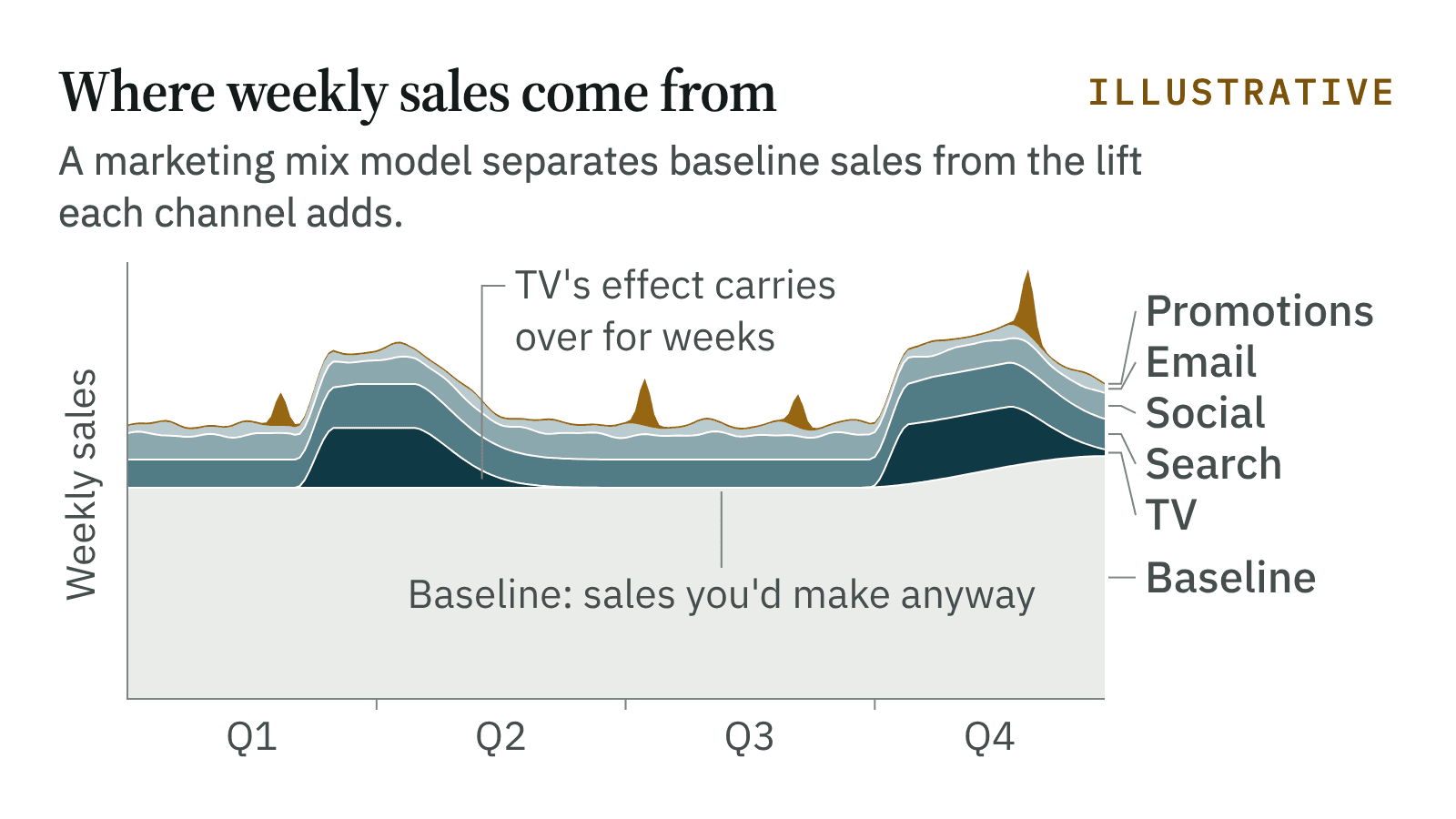
MMM explains your sales over time as the sum of two parts. Baseline sales are the sales you would generate anyway, driven by brand strength, distribution, seasonality, and the economy. Incremental sales are the additional sales generated by each marketing activity, week by week.
You'll also hear it called media mix modeling, market mix modeling, or marketing econometrics, reflecting the econometric methods on which it is based. A media mix model and a marketing mix model are built in the same way. Some practitioners keep the media name for models that cover paid media only, but most use the terms interchangeably.
Because a marketing mix model works on aggregated data, such as weekly spend and impressions by channel, it doesn't need cookies, device IDs, or any other user-level data. Meta's guide to MMM counts this among its key strengths over methods that depend on online tracking signals. It also measures offline channels like TV, radio, print, and out-of-home in the same model as digital ones.
The output answers a short list of practical questions:
- How much revenue did each channel drive?
- What return did each channel deliver relative to its cost?
- Where should the next dollar go?
- How would sales change if you cut a channel or move the budget around?
That list is the reason to build one. MMM belongs to the wider practice of decision intelligence services, where the value of analysis lies in the decisions it informs.
Why MMM Is Making a Comeback
Marketing mix models were in use long before digital advertising. Many teams later moved their budget decisions to user-level attribution because it was faster and more granular.
The challenges of marketing attribution have since caught up with that approach. Attribution follows individual users across touchpoints, and privacy regulations and platform tracking restrictions keep shrinking what it can see. It never saw offline channels at all, so a brand spending on TV or direct mail was only ever measuring part of its marketing efforts.
MMM addresses both limitations by design. It does not require user-level data and treats a TV campaign and a paid search campaign as inputs to the same model. Meta's guide explains why the approach is gaining renewed attention.
How Does Marketing Mix Modeling Work?
At its core, a marketing mix model is a regression model built on weekly data. Sales or revenue is the dependent variable. Spend or impressions by channel, prices, promotions, distribution, holidays, and economic factors are the independent variables.
The model estimates the effect of each input on sales while holding the other variables constant. It's a form of time series analysis, and it needs variation in the data to work. If your TV spend barely changed for two years, no model can tell you what TV did.
Two adjustments make marketing data suitable for regression analysis.
Adstock and Carryover
An ad rarely generates all its sales impact in the week it runs, especially for products and services with longer buying cycles. People see it, remember it, and buy it later. Adstock is the transformation that captures this carryover effect: each week's media impact is spread across the subsequent weeks at a decay rate the model estimates.
Different channels have different decay rates. Meta's guide suggests starting ranges that let TV carry over much longer than digital media, and the model then estimates the rate from your data.
Saturation and Diminishing Returns
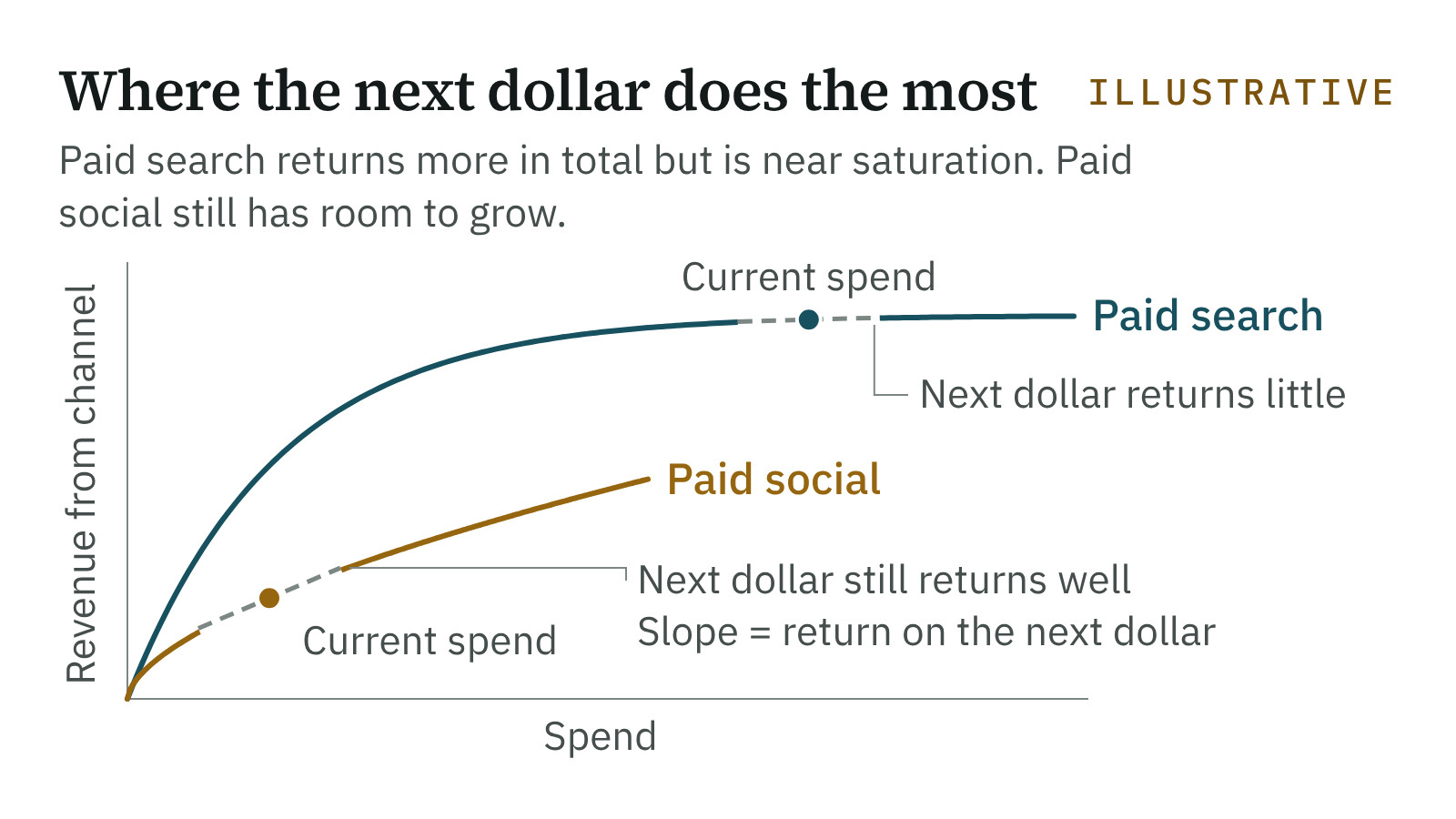
Doubling spend on a channel rarely doubles what it returns. Each additional dollar typically generates a little less value than the one before until the channel is saturated. The model fits a saturation curve, also called a response curve, to each channel to show where it sits on that slope.
This is the part of the output that changes budgets. A channel with a high average return may be near saturation, while a smaller channel with a modest return still has room to grow.
The number that matters for your next decision is marginal ROAS, the return on the next dollar. The average across every dollar you've already spent tells you much less.
Bayesian Marketing Mix Modeling and Machine Learning
Most modern models use one of two approaches. The Bayesian approach starts with prior beliefs about each channel, drawn from earlier models, experiments, or benchmarks, and updates them with your data.
Google researchers outlined the approach in 2017, modeling carryover and diminishing returns together. Their paper also found that with small datasets, the priors drive much of the answer, so where they come from matters.
The second approach takes the marketing mix modeling machine learning route. A common version uses ridge regression to handle inputs that move together, such as TV and search running in the same weeks, and an evolutionary algorithm to search for the best model settings.
When vendors talk about marketing mix modeling AI, they usually mean this kind of automation: faster model selection and faster refreshes. Automated marketing mix modeling saves analyst time. It doesn't fix inputs that disagree with each other, and a model built on inconsistent data is still wrong, however sophisticated the method is.
What Data Do You Need for Marketing Mix Modeling?
Most MMM projects stall in this step. The data required for marketing mix modeling isn't unusual, but it has to be complete and consistent, week by week, for every channel at once.
What goes in:
- Sales or revenue by week, ideally split by region, from your first-party data rather than platform reports.
- Spend for every paid channel, plus impressions or other exposure metrics where you have them.
- Prices, discounts, and the promotion calendar.
- Distribution changes, such as new stores or new marketplaces.
- Holidays, seasonality, and the economic factors that move your category.
How much history you need depends on the model. Meta’s guidance calls for at least two years of weekly data, and four to five years if you only have monthly figures. Models that don’t split results by region typically need three years.
Then comes the work that no tool will do for you. Spend is in every ad platform you use, each with its own naming and its own idea of when a week starts. Promotions live in a merchandising calendar, and revenue probably comes from an e-commerce platform that may not match the finance ledger.
Meta's guide allows four to six weeks for data collection alone on a first study and calls data review one of the most critical steps, because bad inputs produce bad outputs. Garbage in, garbage out, as they say.
A marketing data warehouse that already consolidates these sources turns that work into a one-time job and lets you refresh the model monthly instead of rebuilding it every year. If your data isn't consolidated yet, start with data architecture services. A more advanced model won't make up the difference.
How to Build a Marketing Mix Model
Whether you build in-house or with a partner, the marketing mix modeling workflow follows the same five steps. The same guide lists typical timings for each one, and in a first study they add up to roughly three to five months.
1. Set the Business Questions
Decide what the model has to answer before you collect anything. "Which channels drove sales last year?" needs different inputs than "What happens if we cut TV by a fifth?" or "Does social media perform differently by campaign objective?" The questions set the level of detail for every dataset that follows.
2. Collect and Review the Data
Pull every input into one weekly table, then check it against your media plans and finance records. Look for missing weeks, budget spend that doesn't match invoices, and channels in which spend barely moved, because the model can't measure what didn't vary. This step takes longer than the modeling and decides whether the result is worth using.
3. Build and Validate the Model
Fit the model with adstock and saturation for each channel, then test it. Then check how well it predicts weeks it hasn't seen, whether the channel results make business sense, and whether small changes to the inputs swing the answer. A model that credits your smallest channel with most of your sales is wrong, however good its statistics on fit look.
4. Calibrate With Experiments
Marketing mix model calibration means checking the model against results you know to be causal. If you've run a geo lift test or a conversion lift study on a channel, its measured lift becomes a reference point for what the model says that channel did. Meta recommends calibrating with experimental results wherever you have them.
Incrementality testing and MMM do different jobs. A test measures one channel precisely over a short window. The model puts every channel in context over years.
5. Turn Results Into Decisions, Then Refresh
Translate channel contributions and response curves into a budget plan, run it, and refresh the model as new weeks of data arrive. A model you refresh monthly becomes a planning tool. One you rebuild once a year only tells you what already happened.
Marketing Mix Modeling vs. Attribution
Marketing mix modeling vs. attribution is the comparison most teams start with, and the two answer different questions.
MMM takes the top-down view. It works on aggregated weekly data, covers every channel, including offline ones, and tells you how to split the budget across channels and quarters.
Multi-touch attribution takes the bottom-up view. It follows individual users across digital touchpoints and assigns credit for each conversion. It's fast and granular, so it suits daily decisions about campaigns, keywords, and ad creative.
Marketing attribution tools promise cross-channel marketing attribution, but they can only credit the channels they can track, and their view narrows as tracking signal declines.
| Marketing mix modeling | Multi-touch attribution | |
|---|---|---|
| Data | Aggregated weekly spend and sales | User-level clicks and impressions |
| Channels | Online and offline | Digital only |
| Speed | Weekly or monthly refresh | Near real time |
| Best for | Splitting budget across channels | Optimizing campaigns within a channel |
| Main weakness | Needs years of history | Misses what it can't track |
Media mix modeling vs. attribution modeling isn't a choice you make once. Teams with mature measurement use both: MMM sets the budget split, and attribution guides day-to-day execution inside each channel. Some teams call the combination marketing mix attribution.
Where Unified Marketing Measurement Fits
Unified marketing measurement means running MMM, attribution, and experiments together and reconciling their answers. The model sets the strategic split, experiments check its biggest calls, and attribution handles daily tactics. Much of the incrementality vs. attribution marketing debate comes down to this division of labor: attribution assigns credit, while an experiment shows whether the sale would have happened anyway.
When the three things disagree, investigate why before you pick a number. You also don't need all three on day one.
For most mid-size brands, the order is to get the data consistent, build the model, then add experiments for the channels where the model's answer would move the most money. That sequence is the backbone of any marketing analytics program and of marketing effectiveness measurement more broadly.
Marketing Mix Modeling Advantages and Disadvantages
MMM is built for one job: splitting budget across channels. Know where it helps and where it doesn't before you commission one.
Benefits of Marketing Mix Modeling
- Every channel sits in one model, online and offline, along with price and promotions.
- It needs no cookies or user-level data, so privacy changes and tracking loss don't weaken it.
- You stop crediting marketing for demand you'd have had anyway, because baseline and incremental sales are measured separately.
- Once built, the model can simulate a budget change before you commit to it.
Limitations to Plan For
Most of the limits come from the same place: the method works on aggregate history.
- New channels and channels with flat spend can't be measured reliably because the model needs history and variation.
- Weekly data and monthly refreshes suit budget planning. They're too slow for daily bidding.
- MMM can tell you paid social works. It usually can't tell you which creative works best.
- Every answer carries uncertainty. Google's 2017 paper showed that the budget mix a model recommends can vary widely because the channel estimates themselves are uncertain, so treat the output as a range.
- The model inherits your data's problems. If two systems disagree on what revenue was, it will be confidently wrong. Data governance services that give every metric one agreed definition fix this before it reaches the model.
From Model to Marketing Mix Optimization
Response curves are only useful once they change where your money goes. Marketing mix optimization is the step that helps accomplish this.
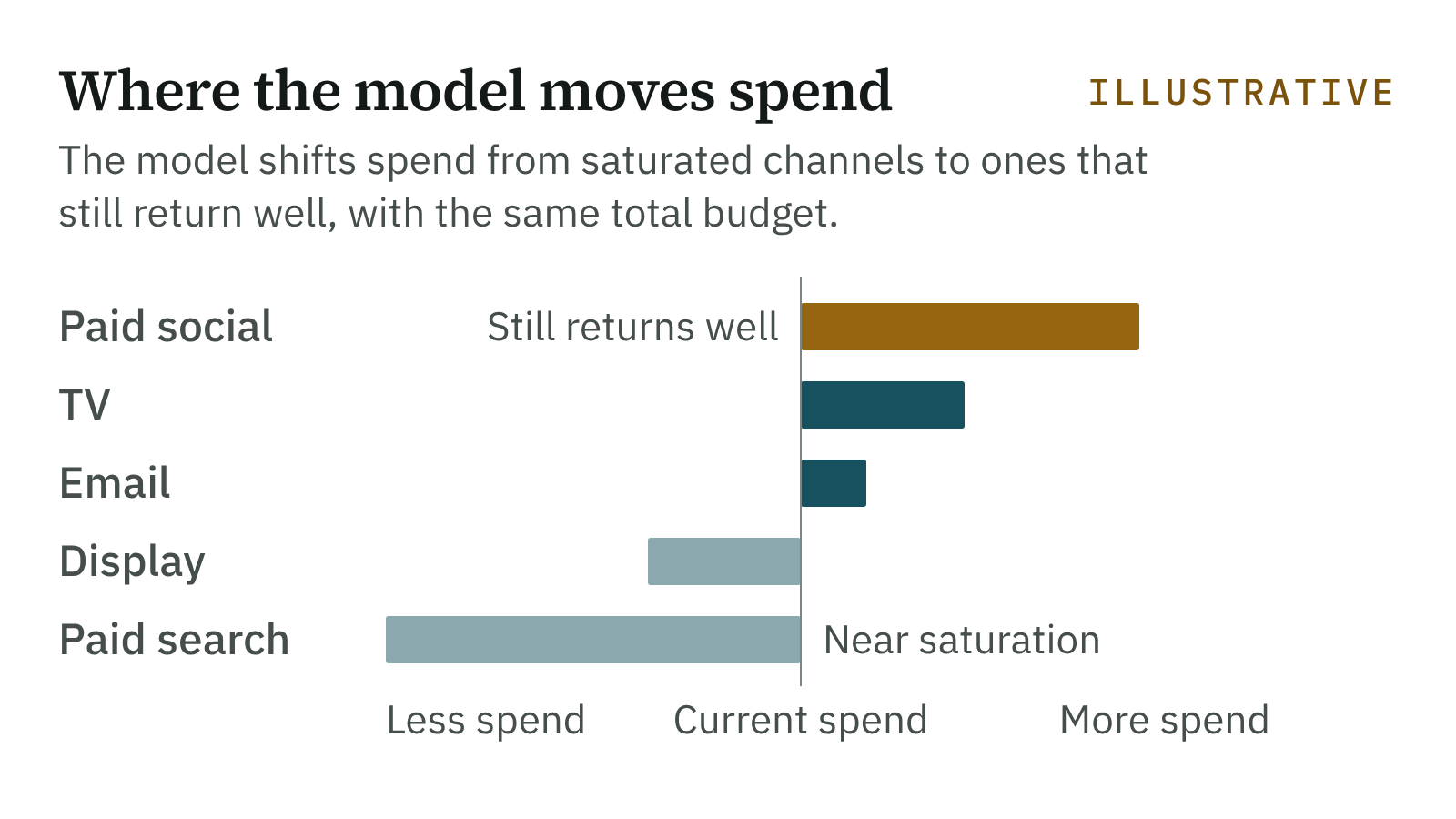
The mechanics are simple once the model is sound. For each channel, the response curve shows what the next dollar returns. Marketing mix modeling optimization moves budget from channels near saturation to channels with room to grow until the marginal returns line up within whatever minimums your contracts and brand plans require.
Scenario planning is the other half. Before you commit to a budget, you test it: what if TV drops by a third, or a fixed amount moves from search into connected TV? This is what-if analysis applied to media spend. It's how the model earns a place in planning meetings.
Done well, this grounds your marketing budget allocation in what each channel returns, measured independently of what each platform reports about itself. That's marketing spend optimization you can defend to finance.
A Marketing Mix Modeling Example
Say a mid-size apparel retailer spends across five channels: paid search, paid social, TV, email, and direct mail. Last-click reports credit paid search with the most online sales, so search keeps getting more budget every quarter.
A marketing mix model built on three years of weekly data tells a different story. Search is close to saturation: its response curve has flattened, and the next dollar there returns far less than its average suggests.
TV, which last-click never credited, is driving a share of the branded searches that search was getting credit for, with a carryover of several weeks. Direct mail, which the team planned to cut, still returns more than it costs at current spending.
The budget plan that follows trims search back toward its efficient level, holds TV, keeps direct mail, and tests a modest increase in social. Before any of it runs, the team tests the new split in the model. It also sets up a geo lift test on TV to check the model's biggest claim.
This marketing mix model example is hypothetical. Each step follows how the method works in practice.
Marketing Mix Modeling Use Cases by Industry
The method is the same everywhere. What changes is which inputs matter most and which decisions the model informs.
Retail Brands
Marketing mix modeling for retail brands has to treat promotions and pricing as carefully as media, because discounts can move more volume than advertising does. A retail model separates the lift from a promotion from the lift from the ads announcing it.
Where the data allows, it also splits results by region or store group. It extends the retail analytics you may already run on store and customer data.
E-commerce and D2C
Marketing mix modeling for e-commerce deals with the most digital-heavy mix and the most platform-reported numbers. Every ad platform can claim the same order, so platform dashboards can add up to more conversions than you had. MMM gives you one model that reconciles to real revenue.
For D2C brands that also sell through marketplaces or retail partners, it can also capture how advertising drives sales in channels you don't track directly.
Hospitality and Travel
A marketing mix model in the hospitality industry has to handle strong seasonality, booking windows that open months before a stay, and the split between direct bookings and bookings through online travel agencies. It shows which channels increase direct bookings rather than commission-paying ones, which matters as much to margin as to volume.
Build, Buy, or Bring In a Partner?
Meta's guide sets out three ways to run MMM: hire a specialist vendor, use a software platform, or build it in-house. Each suits a different kind of team.
Building in-house gives you full control over the model, but it requires more than modeling skills. Your team needs data engineering to consolidate and maintain the inputs, statisticians to validate and calibrate the results, and computing infrastructure, including GPUs for the more demanding approaches, to run and refresh the model. It suits companies that already have an analytics team with available capacity and consolidated data.
Marketing mix modeling software suits teams with less statistical depth. You get point-and-click modeling and planning tools, with less consultation and less control over how the model is built.
A specialist partner does the most work for you, from data collection through to recommendations, and is usually the most expensive route. What you pay for is experience. A team that has built models before already knows the data problems, validation checks, and calibration steps that slow a first model down, and you don't have to hire for any of it.
How We Build a Marketing Mix Model
We work as that kind of partner: independent enough to give you the real answer, accountable enough to fix what we find. Our marketing mix modeling methodology follows five steps, and you see what goes in and how each recommendation was reached.
- Data preparation. We reconcile your spend, delivery, and revenue data for every channel into one weekly dataset and fix the gaps before modeling starts.
- Feature engineering. We estimate adstock and saturation for each of your channels from your own data.
- External context. We add seasonality, pricing, promotions, economic indicators, and competitor activity where it’s available, so your media isn’t credited with demand it didn’t create.
- Modeling. We combine more than one modeling framework, test the result on weeks it hasn’t been seen, and calibrate it with incrementality testing, such as geo lift tests, where you have them.
- Decisioning. We turn the results into a budget plan built on marginal ROAS, and you test each scenario in the model before you commit money.
That's the route we offer at Express Analytics: independent enough to give you the real answer, accountable enough to fix what we find.
Each option depends on the same thing: complete, consistent data. No tool or vendor can correct inputs that disagree with each other, so the data question comes first, whichever route you pick.
Start With the Data Under the Model
Marketing mix modeling is only as trustworthy as the data under it, so we check the data first.
Before you invest in a model, you need to know whether your data can support one. That means checking whether spend, revenue, and promotions reconcile across systems and whether you have enough history and variation.
If it can, our marketing mix modeling services take you from raw data to a model to a budget plan on the platform you already own. We stay to refresh and implement it. If it can't, we'll tell you what to fix first.
If you're weighing a marketing mix modeling consultant against an in-house build, the first step is the same either way.
One question decides where to start: do you have a data warehouse or lakehouse with your key data sources already consolidated into it? If not, or only partly, start with a Data Readiness Assessment. If yes, an AI Readiness Assessment checks whether that foundation holds up for the models and automated decisions you want to run on it.
That's the approach behind everything we do. Readiness is where we start. Implementation is where we stay.
Final Thought
Marketing mix modeling answers the question the person who signs off on the budget is asking: what does each channel return, and what will the next dollar do? The method is well established.
What decides whether your model gets used is the data underneath it. Get that consistent and complete, and the budget conversation moves from whose report to believe to what to do next.
Get in touch to start with a Data Readiness or AI Readiness Assessment. We'll show you what your data can support and what to fix first, then build your marketing mix model on the platform you already own.