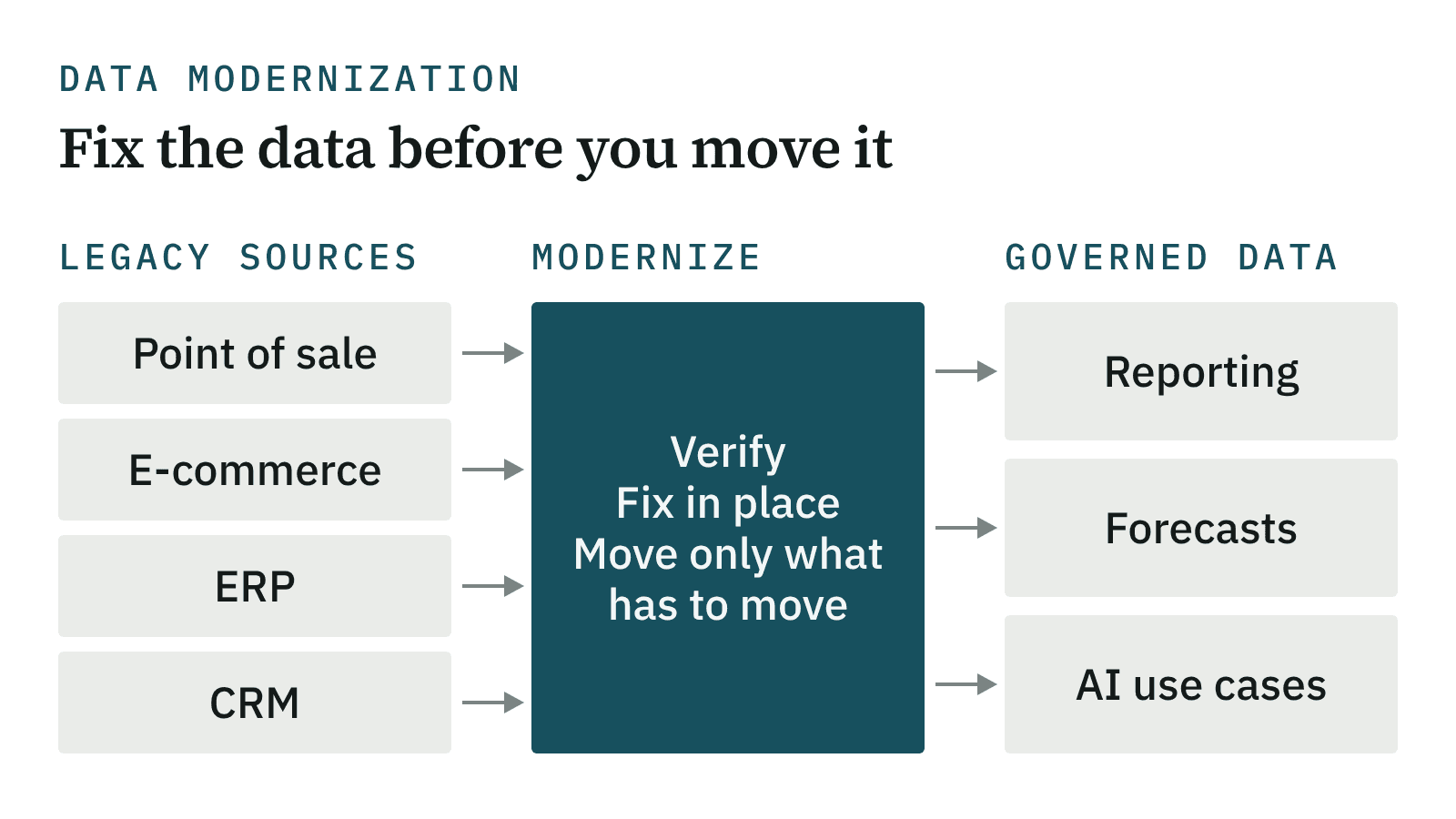
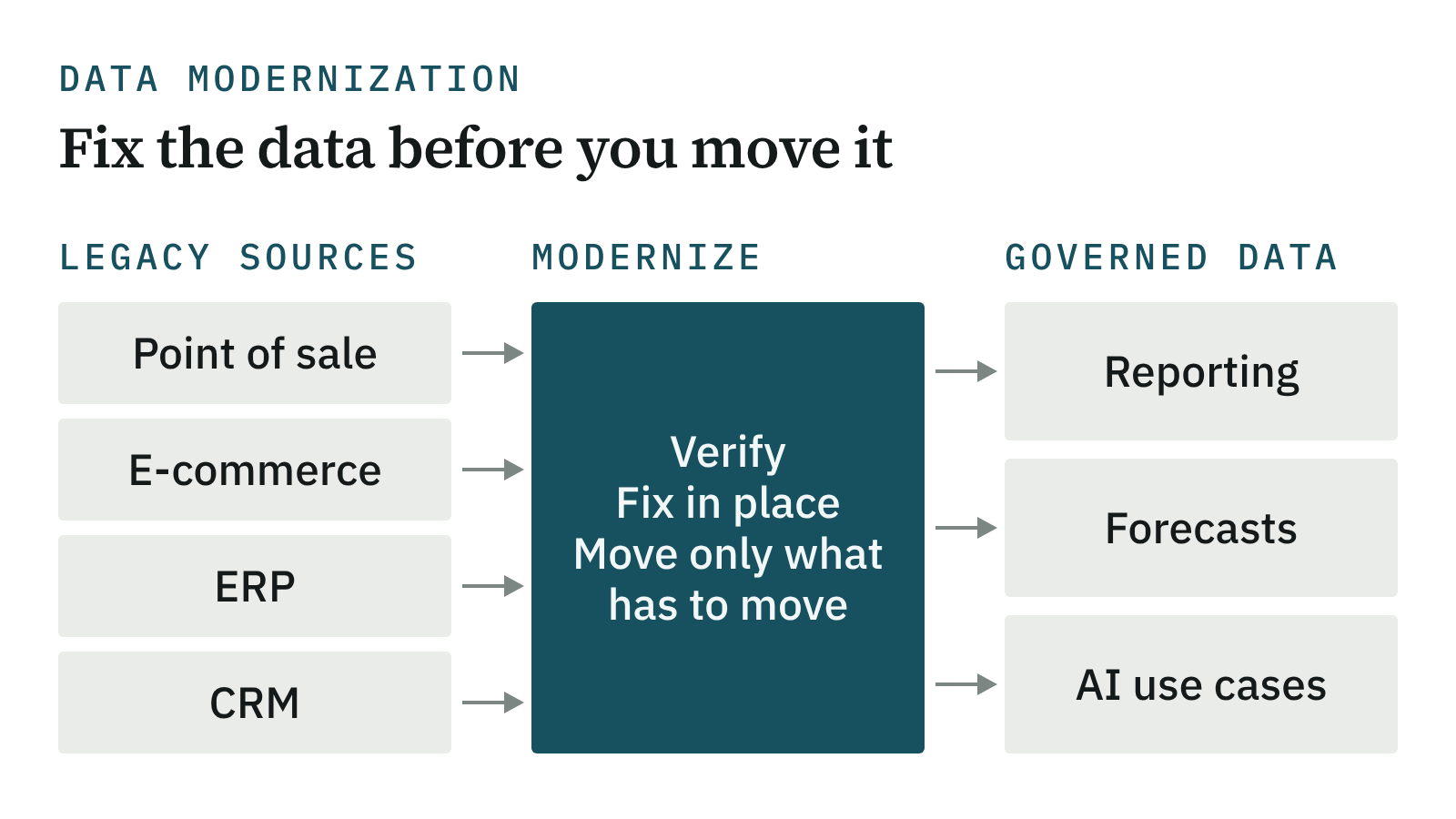
Data modernization is the process of updating how an organization stores, integrates, governs, and uses its data so that the data supports current decisions, reporting, and AI. It covers the data platform and the pipelines that feed it. It also covers the controls that make the numbers trustworthy and the way people access the data.
For a CIO, the harder question is sequence. You need to know which data to fix, which systems to keep, and which workloads to move, and in what order.
Our own approach, described at the end of this page, starts with evidence about the data you already have.
What Is Data Modernization?
In practice, the work replaces or upgrades the parts of a data estate that no longer support the business. The term covers more than a new platform. It includes the pipelines that move data, the rules that govern it, and the reporting and analysis built on it.
Data platform modernization is the narrower part of that work. It concerns the warehouse, lakehouse, or database layer where data is stored and processed. A new platform does not change how much your teams trust the numbers, so most programs extend to integration, governance, and access.
Enterprise data modernization usually runs as a program rather than a single project. Each data domain, such as customers or products, moves through the work on its own schedule. That allows the business to keep running on the old systems while the new foundation is built and verified.
The goal is the same at any scale. Your teams should be able to answer business questions from one set of governed data, quickly enough to act on the answer. That is also the foundation decision intelligence depends on, where data feeds specific operational and commercial decisions rather than reports alone.
Data Modernization vs. Data Migration
Data migration moves data from one system to another. Data modernization changes how the data is structured, governed, and used. A migration is often one step inside a data modernization program.
The difference matters because a migration can finish on schedule and still leave the business with the same problems. Duplicate customer records, conflicting revenue definitions, and undocumented transformations do not improve when they move. They become problems on the new platform.
| Data migrationData modernization | ||
| Goal | Move data to a new system | Make data support current decisions and AI |
| Scope | Data, schemas, and jobs | Platform, pipelines, governance, and access |
| Done when | Data is loaded and validated | Teams use governed data for decisions |
| Main risk | Data loss or downtime during cutover | Existing quality problems move to the new platform |
A data warehouse migration is a common example. Moving a legacy data warehouse to a cloud platform with the same tables and jobs is called lift and shift. It reduces infrastructure work, but it keeps every definition and quality issue the old warehouse had.
Replatforming makes only the changes the new platform requires. Data warehouse modernization goes further still. The tables are redesigned around current reporting needs, the jobs are rebuilt as monitored pipelines, and each data set gets an owner.
Every option needs data reconciliation before the old system is switched off. Someone has to show that the new system produces the same totals, or explain each difference. The legacy data migration itself, moving records out of the old system, is one part of that plan.
Where It Fits in Your IT Modernization Strategy
Data modernization is one workstream inside an IT modernization strategy. Legacy system modernization usually covers applications and infrastructure, such as replacing old software or moving workloads to the cloud. The data layer decides whether the reports and AI built on those systems can be trusted.
That is why data work often lags behind the application program. An application can go live on a new platform while its data still flows through old extracts, spreadsheets, and undocumented jobs. Your teams then reconcile numbers by hand, and leadership sees different totals in different reports.
The accumulated cost of those workarounds is called data debt. It is the data equivalent of technical debt, the extra cost of maintaining systems that were built for speed rather than for maintenance. Data debt grows each time a team adds a workaround instead of fixing the source.
The ROI of legacy system modernization is usually argued on infrastructure cost. The case rests on fewer licenses, less hardware, and fewer specialists to maintain old systems. Those savings leave out the cost of legacy data: decisions made late, or made on numbers nobody trusts.
A complete business case adds two lines. The first is the total cost of ownership of your current data estate, including the staff time spent reconciling reports. The second is the value of the decisions that depend on faster, governed data, such as inventory buys and marketing spend.
For a CIO, this changes the order of work. Legacy modernization programs that leave data until the final migration step tend to carry their data debt onto the new platform. The data foundation should be modernized before, or alongside, the applications that depend on it.
The Components of Data Modernization
Most data modernization programs work on four components. Each one can be modernized on its own schedule, so you can start where the business impact is largest. Changes to storage and compute are sometimes called data infrastructure modernization, but infrastructure is only the first of the four.
Data Architecture Modernization
Data architecture modernization changes where data is stored and processed. The usual move is from separate operational databases and an aging warehouse to a consolidated platform, either an enterprise data warehouse or a data lakehouse. A lakehouse combines the low-cost file storage of a data lake with the management features of a warehouse.
A modern data architecture separates storage from compute, so each can scale with demand. It also keeps raw data, cleaned data, and reporting tables in separate layers, so a change in one layer does not break the others.
The term modern data platform describes the result: one governed place where data from every source system can be combined. If you already run a warehouse or lakehouse, data architecture modernization usually means restructuring the data on that platform instead of buying another one.
Legacy Data Integration and Pipelines
Legacy data integration connects old source systems to the new platform. Many legacy systems, such as point-of-sale and enterprise resource planning (ERP) systems, will stay in place for years. The goal is to extract their data reliably rather than replace them.
Older pipelines often use ETL, which transforms data before loading it, in jobs that are hard to change and rarely documented. Modern pipelines more often load raw data first and transform it inside the platform, which keeps an untouched copy of the source data. Either way, each data pipeline needs monitoring, so a failed load is caught before it reaches a report.
This is also where data consolidation happens. Records for the same customer or product from different systems are matched into one version, so every report counts them once.
Governance, Lineage and Ownership
Governance gives each important data set an owner, a written definition, and quality checks. Without it, teams on the new platform keep disputing which revenue figure is correct. Checks for completeness, freshness, and accuracy are the core of data quality work, and they need to run on every load.
Data lineage records where each number came from and how it was transformed. It lets an analyst trace a wrong total back to the step that caused it.
A data catalog makes those definitions and owners searchable for the whole business. Our data governance services cover ownership, quality checks, and lineage on the platform you already run.
Data Analytics Modernization
Data analytics modernization changes how people use the data once it can be trusted. It replaces manual report builds and spreadsheet extracts with shared metrics, governed dashboards, and self-service access for analysts.
The main change is agreement on definitions. When finance and marketing calculate revenue from the same governed tables, both teams report the same figure.
Data and analytics modernization works best when the reporting layer changes last, after the data underneath it has been verified. If dashboards are rebuilt first, they display the same disputed numbers in a new format.
Does Data Modernization Mean Moving to the Cloud?
No. Cloud data modernization is common, because cloud platforms scale storage and compute separately and remove hardware maintenance. Moving to the cloud is still one option among several, and some workloads are better modernized where they are.
The decision should be made workload by workload. For each data set and pipeline, there are four options:
- Keep it as it is, if it already meets the needs of the decisions it supports.
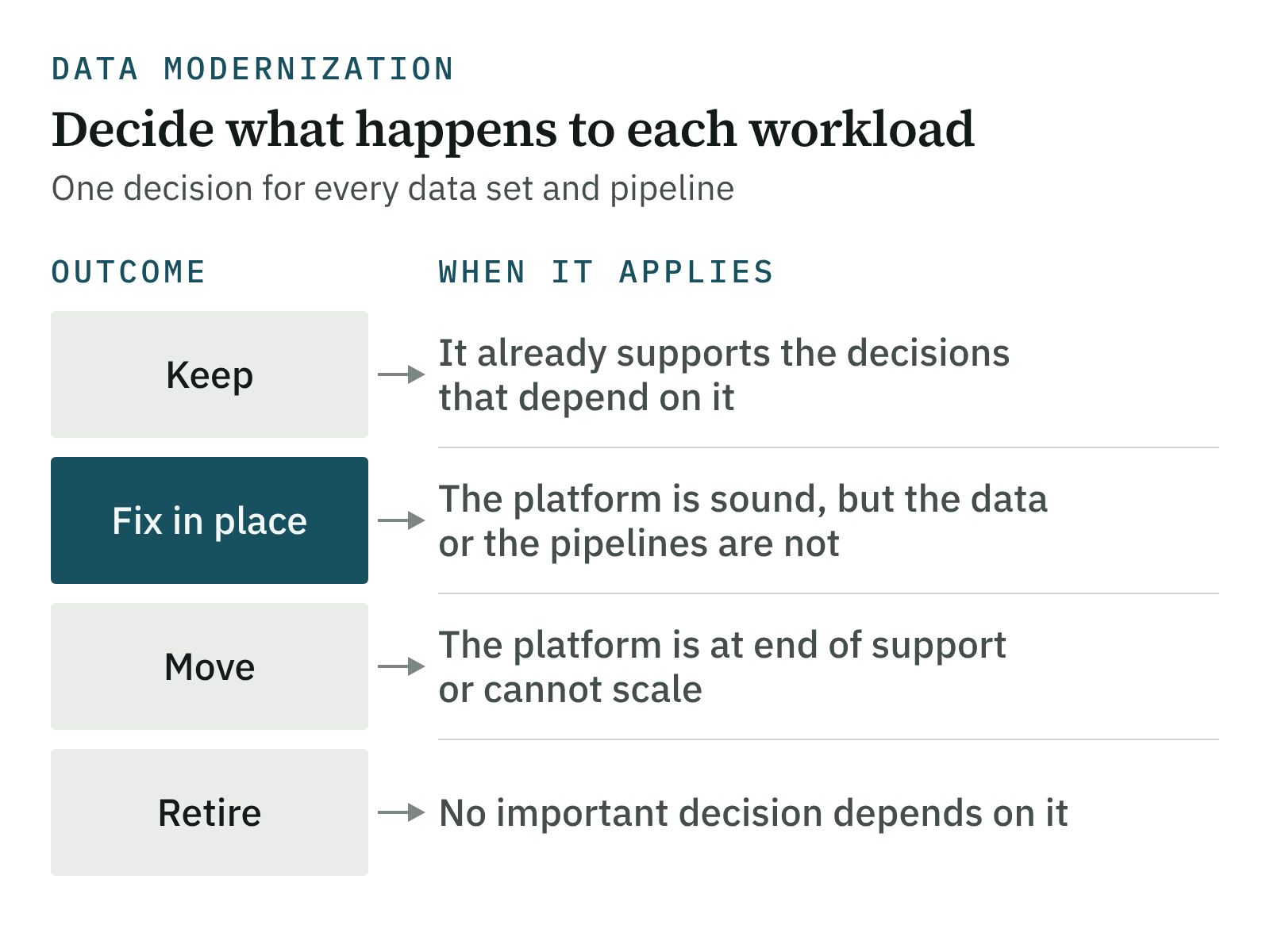
Data modernization in cloud environments is worth the cost for the workloads in the third group. Moving the other workloads adds cost and risk without changing what the business can do with the data.
Teams that talk about data estate modernization often mean this full inventory. Every database, warehouse, pipeline, and report gets a decision attached.
Enterprise data warehouse modernization follows the same logic. If your warehouse is on-premises but well designed, a cloud move can wait until the data in it is reconciled and governed. When a move is justified, a cloud migration strategy and a cloud readiness assessment set the order and check the dependencies before anything moves.
How to Build a Data Modernization Strategy and Roadmap
A data modernization strategy decides what to modernize, in what order, and how you will know it worked. The data modernization roadmap turns that strategy into dated work. The five steps below apply whether you run the work in-house or with a partner.
1. Start From the Decisions the Data Supports
List the decisions that matter most to your business, such as inventory buys, pricing, and marketing budget allocation. Then identify the data each decision depends on.
That list sets the priorities. The age of a system matters only when it puts one of those decisions at risk.
2. Inventory Sources, Pipelines and Owners
Map every source system, pipeline, and report that feeds those decisions. Record who owns each one, how often it fails, and how many people rely on it.
An analytics maturity model can help you place each area on a common scale before you compare them. A data modernization framework, whether from an industry body or your own team, is useful only if it produces this kind of ordered inventory.
3. Decide Keep, Fix, Move or Retire for Each Workload
Apply the four options from the previous section to every workload on the inventory. In many data estates, the result is a shorter migration list than the one in the original plan, because some workloads need fixing rather than moving.
4. Sequence the Work by Business Impact
Order the work by the value of the decisions it improves, then by risk. Each item on the data modernization roadmap should have a milestone, a description of the work, and a plan for the legacy system it replaces.
The US Government Accountability Office (GAO) lists those three elements as the minimum for a modernization plan. In its July 2025 review of federal legacy systems, the GAO found that incomplete plans increase the likelihood of cost overruns, schedule delays, and project failure.
5. Reconcile Before You Switch Off the Old System
Run the old and new systems in parallel until their outputs match, or until every difference is explained. Replacing one data domain at a time, an approach based on the strangler fig pattern, keeps the business running on proven data while each part moves.
This phased migration takes longer than a single cutover. It also gives you a working rollback at every step. Treat each domain as its own data modernization initiative, with a business owner who signs off on the reconciled numbers.
Benefits of Data Modernization, and Its Limits
The benefits of data modernization show up in your decisions and in the cost of running your data. They include:
- Teams report from one set of governed numbers, so meetings start from agreed figures.
Data modernization benefits depend on the governance work being done. Data platform modernization with the old definitions delivers lower running costs and few of the other benefits.
The work also has limits. It does not settle disagreements about definitions by itself, because the business owners have to agree on them. It disrupts the teams who maintain the old systems and reports.
The timelines also tend to run long, because the data problems are usually larger than the first inventory suggested. These are the common data modernization challenges, and most of them are organizational rather than technical.
The same pattern appears in legacy modernization challenges more broadly. Projects stall when no one owns the outcome or when scope grows during the work. They also stall when the old system cannot be switched off because nobody verified the new one.
Modernizing Retail and E-commerce Data
Data modernization in retail usually starts with systems that were never designed to share data: point-of-sale, the e-commerce platform, and the ERP that holds inventory and cost. Loyalty and marketing platforms add customer data with their own identifiers.
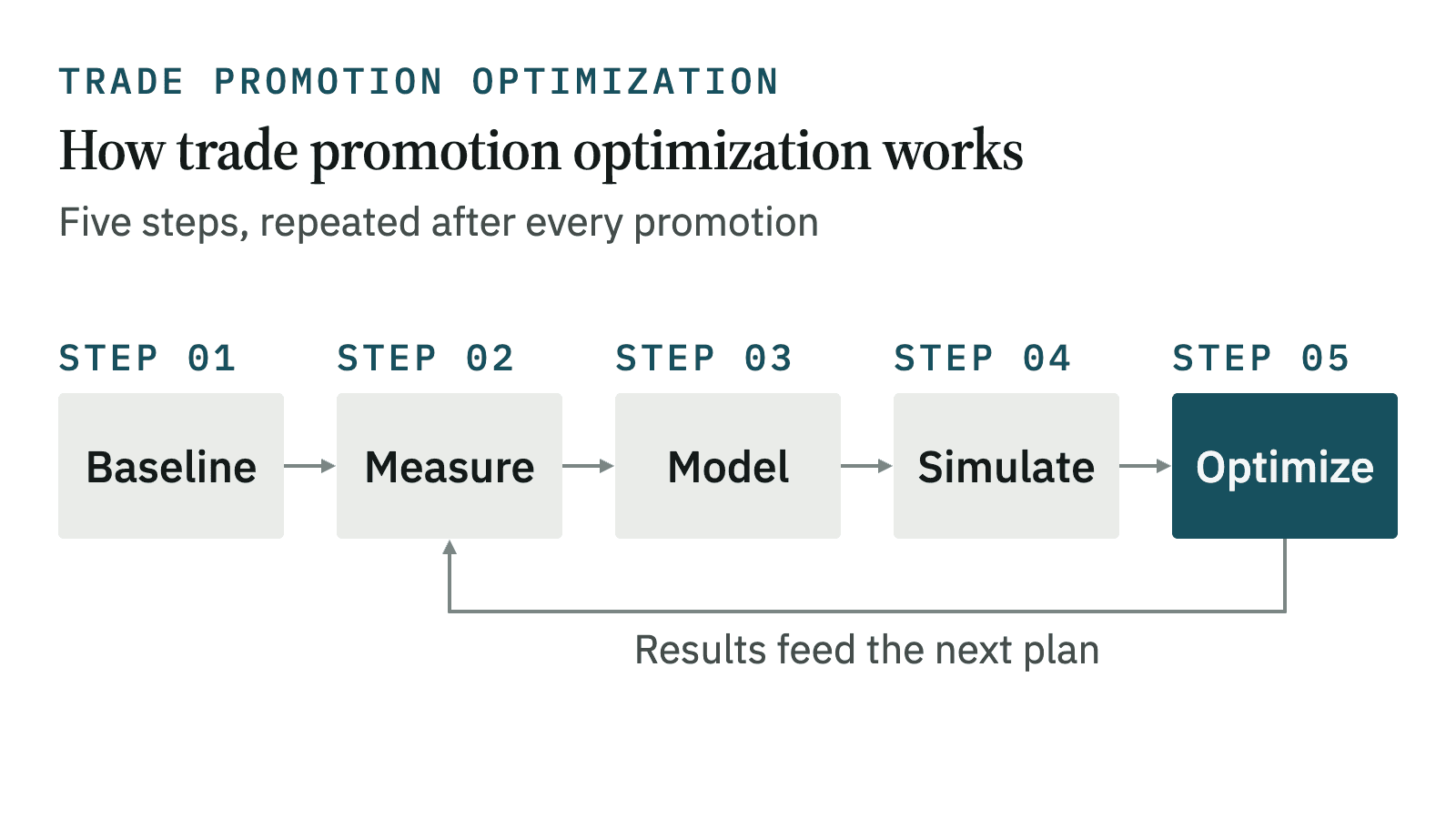
Most retail decisions need all of these sources joined. Inventory planning needs store and online sales against stock. Promotion planning needs sales, prices, and costs by product and week, which is the data behind retail promotion optimization.
The common failure is a product or customer that has a different identifier in each system. Until those identifiers are mapped to one master record, every report that combines channels needs manual matching. That mapping, and the pipelines that keep it current, are also what make retail analytics across channels possible.
The same applies to direct-to-consumer (D2C) brands and to hospitality groups. In hospitality, booking, property, and loyalty systems each hold a separate record of the same guest.
Data Modernization for AI
Data modernization for AI raises the standard the data has to meet. Data that is good enough for dashboards is not automatically good enough for AI agents. A person reading a report can catch a wrong number before acting on it, while an agent acting on the same number compounds the error.
The gap is common. In a February 2025 release, Gartner said 63% of organizations "either do not have or are unsure if they have the right data management practices for AI." The release draws on a survey of 1,203 data management leaders run in July 2024. Gartner predicts that through 2026, organizations will abandon 60% of AI projects that are not supported by AI-ready data.
Gartner advises organizations to build on their existing data management practices and extend them for AI use cases. That supports modernizing the platform you already own. An AI readiness checklist shows which parts of your data foundation need work before a specific AI use case.
How We Approach Data Modernization
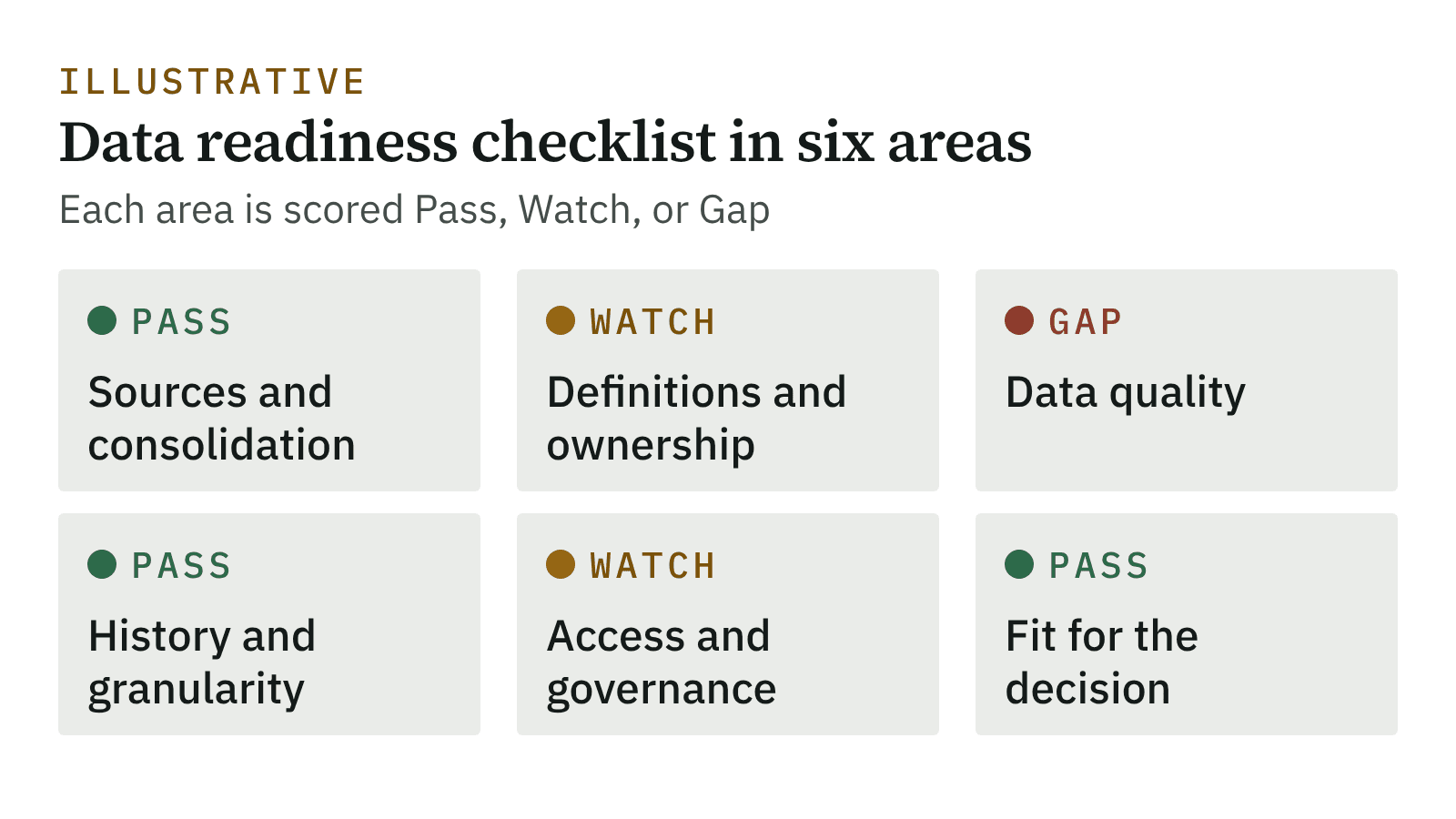
We start every data modernization program with evidence about the data you already have. That first step is a data modernization assessment. It verifies your sources, pipelines, quality, lineage, and ownership against the decisions they support, instead of relying on interviews alone.
One question decides where to start. Do you have a data warehouse or lakehouse with your key data sources already consolidated into it?
If not, or only partly, start with a Data Readiness Assessment. If yes, an AI Readiness Assessment checks whether that foundation will hold up for the AI use cases you plan.
Our approach follows five steps:
- Start from the decisions your data has to support.
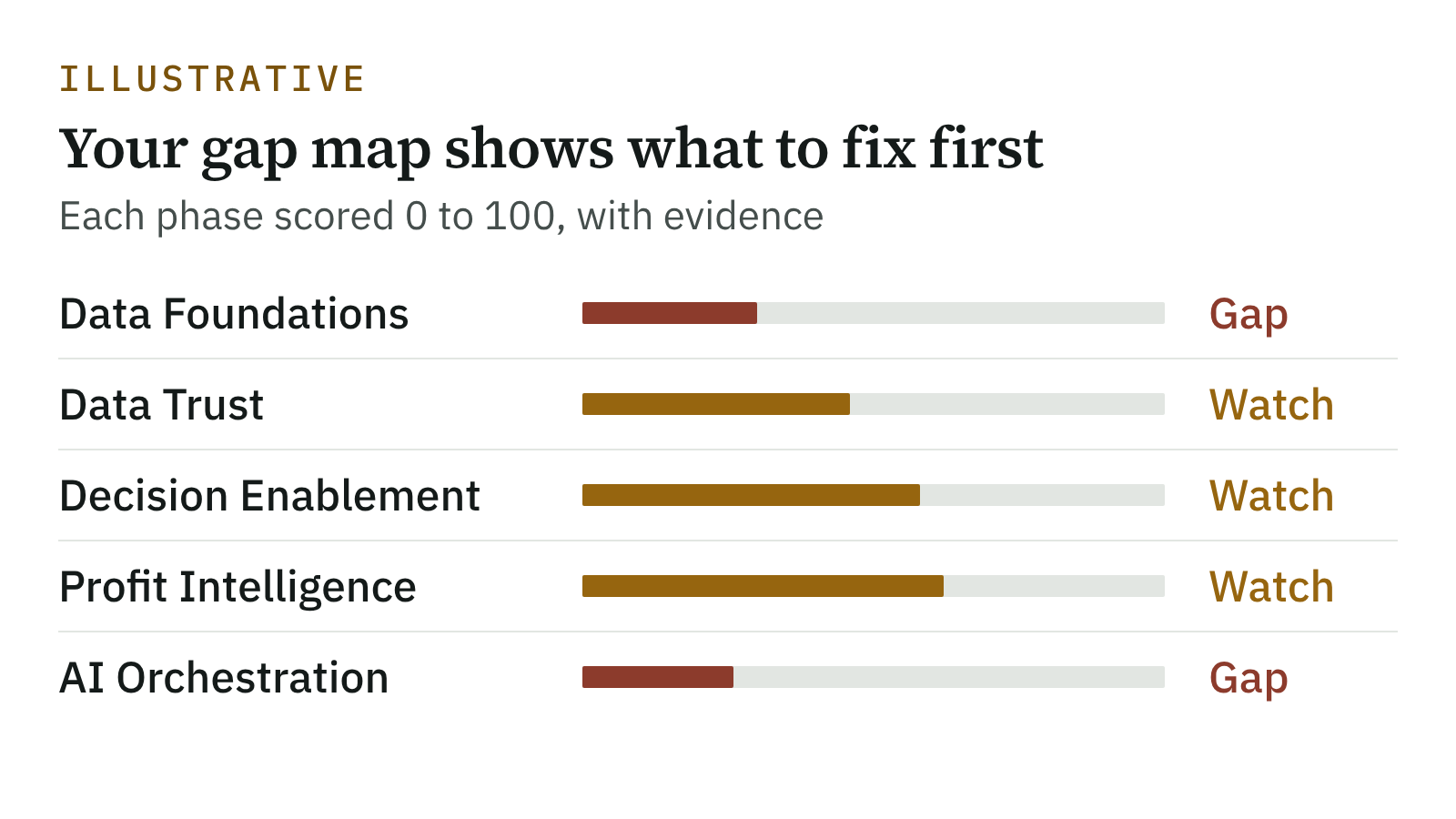
You get a scored gap map, a data modernization roadmap, and a list of what to fix first. If you need data modernization services beyond the assessment, the same team that found the gaps builds the fixes through our data engineering solutions.
Readiness is where we start. Implementation is where we stay.
Final Thought
Data modernization is measured by the decisions it improves. For a CIO, most of the work is deciding which workloads to fix, keep, move, or retire, and in what order.
Get in touch to start with a Data Readiness Assessment or an AI Readiness Assessment. We will show you what your data can support and what to fix first, then build on the platform you already own.