
Decision intelligence (DI) is the discipline of designing business decisions, then measuring and improving them with data, analytics, and AI. It treats each recurring decision as something a business can model and test, then refine as results come in.
A dashboard can show that margin fell last month. It rarely says who should act on that, which options they have, or how anyone will know whether the response worked. DI starts from the decision, so those questions get answered first.
What Is Decision Intelligence?
The standard decision intelligence definition comes from Gartner. It describes a practical discipline that makes explicit how decisions are made, then evaluates and improves their outcomes through feedback. A decision becomes something an organization designs and tests, in the same way it designs a product or a process.
DI draws on older fields. Decision theory, the study of how to choose between options under uncertainty, supplies the logic for weighing choices, and decision analysis applies that logic to business problems.
Decision science and data science contribute the methods for measuring outcomes and building predictive models. Machine learning then lets those models run on high-volume decisions that a team could not review by hand. A related practice, decision engineering, applies engineering methods to decision-making with less emphasis on data.
DI differs from analytics in its unit of work. Analytics produces an insight, while DI produces a decision with an owner, a set of options, and an outcome that someone checks. The benefits follow from that structure: the same decision is made the same way each time, and you can see which choices worked.
How Decision Intelligence Works
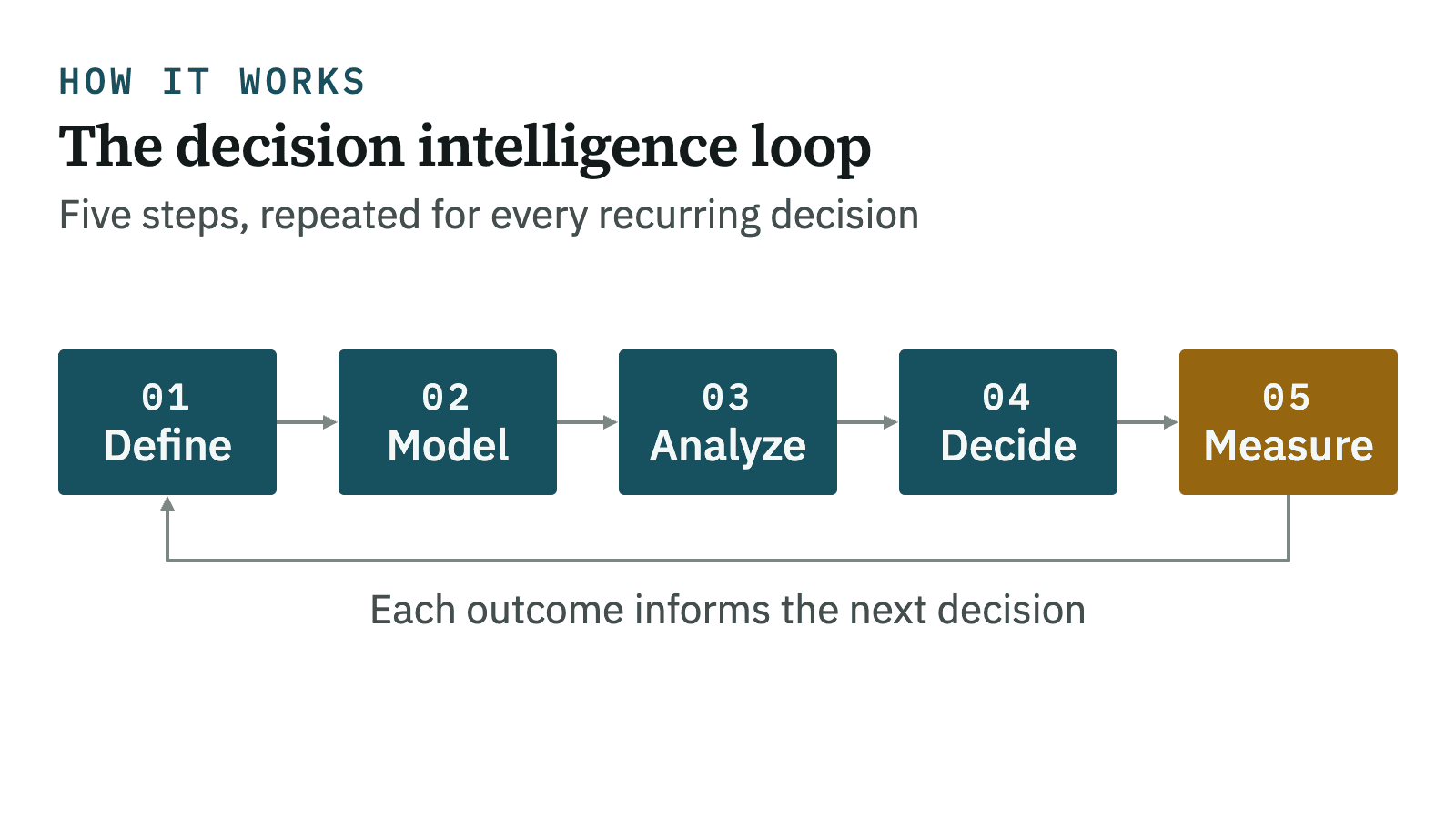
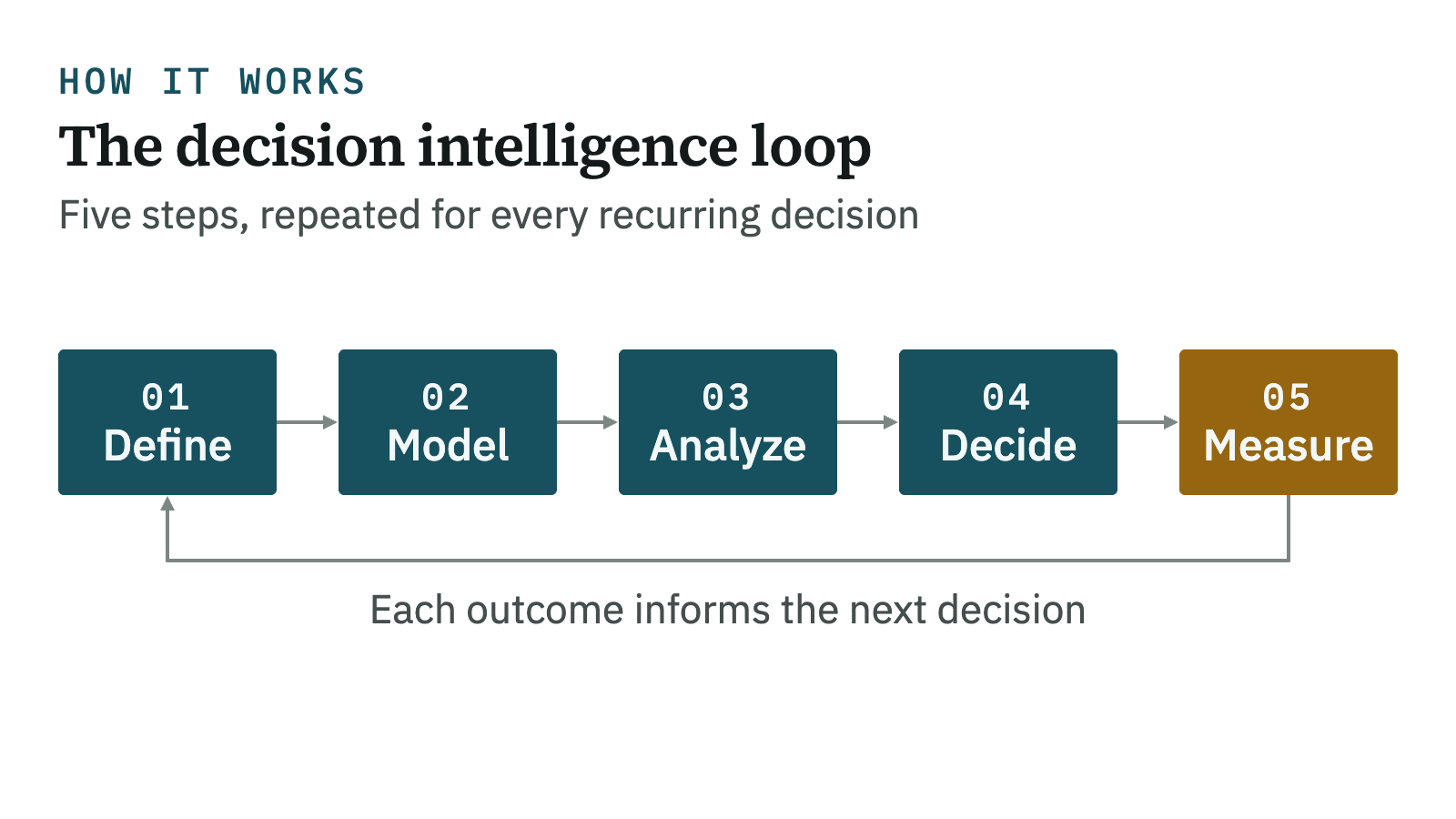
DI runs as a loop. It starts by defining a decision and ends by measuring the outcome, which then informs the next round. Published frameworks use different names for the steps, but they cover the same five.
1. Define the Decision
Start with one decision that recurs and has a measurable result. Write down who owns it, which options are open, and what the objective is. Then list the constraints, such as budget, stock levels, or contract terms.
Operational decisions, such as daily prices or reorder quantities, are the usual starting point because they repeat often enough to learn from. Strategic decisions, such as entering a new market, use the same steps less often.
2. Model the Decision
Decision modeling maps how each option leads to an outcome. A decision model links the action you control, such as a price change, to effects like demand and margin, and from there to the business result. Business rules, such as a minimum margin, sit inside the model as fixed limits.
Decision Model and Notation (DMN), a standard from the Object Management Group, describes decision logic in a form that both business teams and developers can read. A causal decision diagram draws the chain from action to outcome as a map that non-specialists can follow.
3. Analyze the Options
Descriptive analytics shows what happened, and predictive analytics estimates what will happen under current conditions. Prescriptive analytics recommends the option that best meets the objective within the constraints.
Scenario modeling tests several options side by side before anyone commits. What-if analysis changes one input at a time to show how sensitive the result is to it.
When there are too many options to compare by hand, decision optimization searches for the combination that best meets the objective. It draws on operations research, the field that applies mathematical modeling to problems such as scheduling and resource allocation.
4. Support, Augment, or Automate
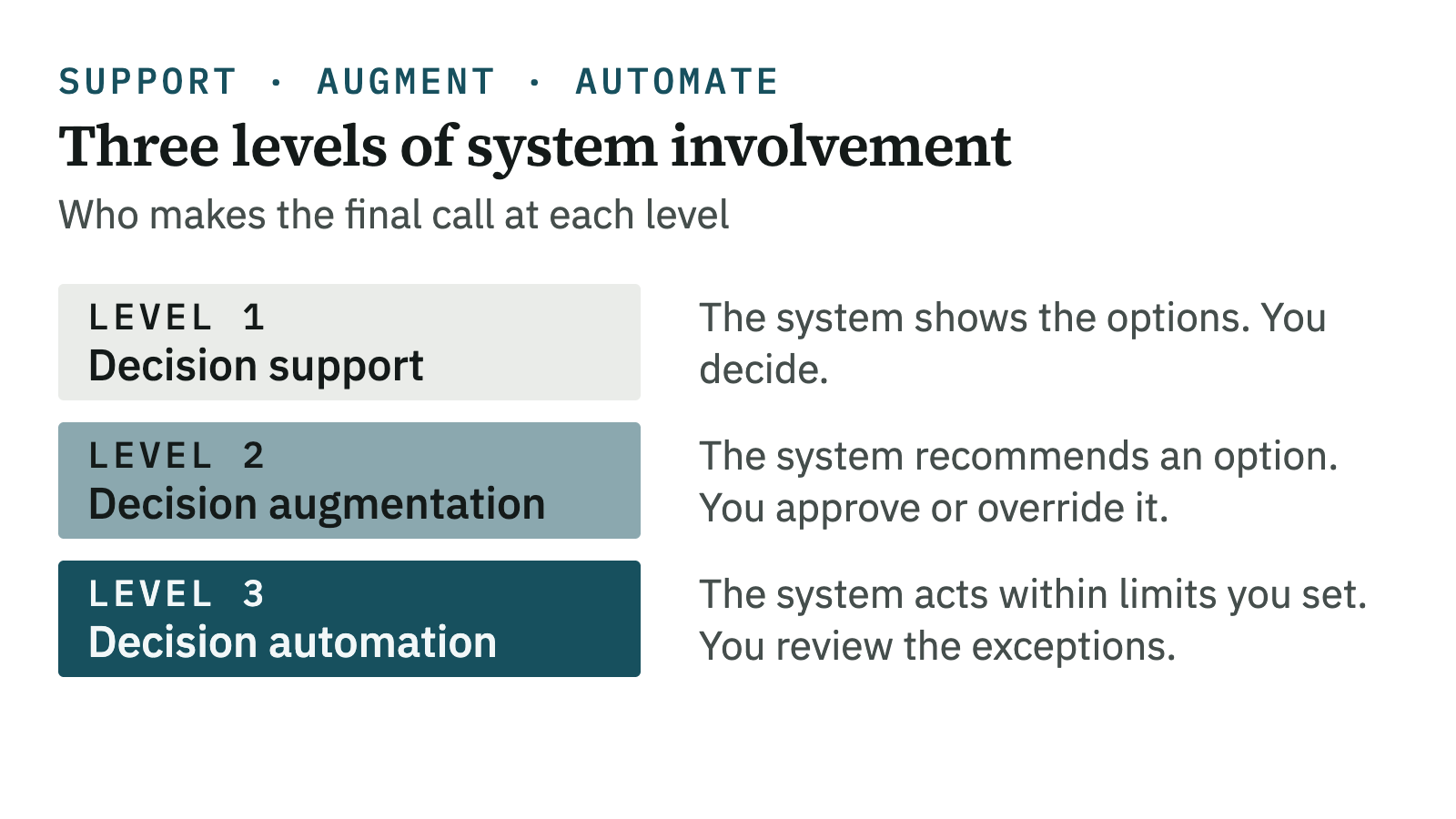
Systems take on decisions at three levels. Decision support gives a person information and leaves the choice to them. With decision augmentation, the system recommends an option, often as a next best action, and a person approves or overrides it.
Augmented decision-making suits decisions where context matters, and errors are costly. Decision automation lets the system act within set limits, which suits high-volume, low-risk decisions such as routine reorders. AI decisioning covers automated decisions in more depth.
Human-in-the-loop decision-making sits between the levels. A person reviews exceptions and any action that changes prices, customer records, or spending above a set threshold.
5. Measure the Outcome
Every decision gets a decision record: what was known, which option was chosen, what was expected, and what happened. Comparing expected and actual results closes the feedback loop and shows whether the model needs adjusting.
Over time, those records let you measure decision quality separately from luck. A sound decision can still produce a poor outcome, and the record shows whether the reasoning or the circumstances caused it.
Where AI Fits
AI decision intelligence uses machine learning in steps 3 and 4 to predict outcomes, recommend options, and act within set limits. It can cover more decisions than a team working by hand. It still depends on the same model, records, and data as any other approach.
Agentic decision intelligence hands the action itself to AI agents, which carry out decisions across systems, such as adjusting a price or pausing a campaign. Data that is good enough for a dashboard is not automatically good enough for an agent acting on it.
Automated decisions also need decision intelligence governance: who approved the logic, which limits apply, and how each automated action can be traced and reversed.
Decision Intelligence vs. Business Intelligence
Business intelligence (BI) reports what happened. DI starts from a decision and works back to the data, models, and actions that the decision needs.
A BI dashboard shows that returns rose in one region. A DI view also shows who owns the response, which options they have, and whether last month's response worked. That is how decision intelligence addresses BI limitations: it ties each report to a decision that someone owns.
| Business intelligenceDecision intelligence | ||
| Starts from | The data | The decision |
| Main output | Reports and dashboards | Decisions, recommendations, and actions |
| Question it answers | What happened? | What should we do, and did it work? |
| Who acts | A person reads the report and decides | A person, a system, or both, within set limits |
| Feedback | Rarely tracked | Each outcome is recorded and reviewed |
DI also builds on decision support systems, information systems built to help managers make specific decisions, and decision analytics, which applies statistics to business choices. It adds modern data platforms and a formal feedback loop.
Decision Intelligence Use Cases and Examples
Decisions that suit DI share three traits: the decision recurs, the options are clear, and the outcome can be measured within weeks or months. Pricing, replenishment, staffing, and budget allocation all fit. In finance, DI applies the same steps to credit limits and fraud screening, with stricter requirements for explaining each decision.
The decision intelligence examples below are hypothetical. Each one follows how the method works in practice.
Commercial Decision Intelligence in Retail
Prices, markdowns, promotions, and stock allocation are the decisions that move retail revenue and margin. Markdown optimization is a common starting point for decision intelligence in retail, because the decision repeats every season and the result shows up in sell-through.
Say a sporting goods retailer marks down slow sellers by a flat 30% after eight weeks. A decision model links markdown depth and timing to sell-through, margin, and remaining stock by store. The team tests three schedules in the model, picks the one that clears stock at the highest margin, and records the expected result.
Eight weeks later, the record shows whether the new schedule outperformed the flat rule. The same loop applies to price optimization in e-commerce and to room rates in hospitality.
Decision Intelligence for Marketing
DI treats budget allocation as a decision with an owner, options, and a measured result, rather than as a reporting exercise. Marketing mix modeling supplies the inputs by estimating what each channel contributes to revenue, and experiments check the largest estimates.
Say a direct-to-consumer (D2C) brand plans its quarterly budget across paid search, paid social, and email. The decision model links spend by channel to incremental revenue, with a minimum for brand campaigns as a business rule. The team compares two budget splits in the model before committing to one, and the decision record holds the revenue it expects.
At the end of the quarter, the record shows how close the forecast came. Marketing decision intelligence repeats that loop every quarter, so each plan starts from the results of the last one.
Choosing Decision Intelligence Platforms
A decision intelligence platform is software that supports, augments, or automates decisions using data, analytics, knowledge, and AI. That is how Gartner describes the category, which covers very different products, so the label alone tells you little.
Before you compare features, check four things:
- The platform models decisions explicitly, so a business user can read the logic behind each recommendation.
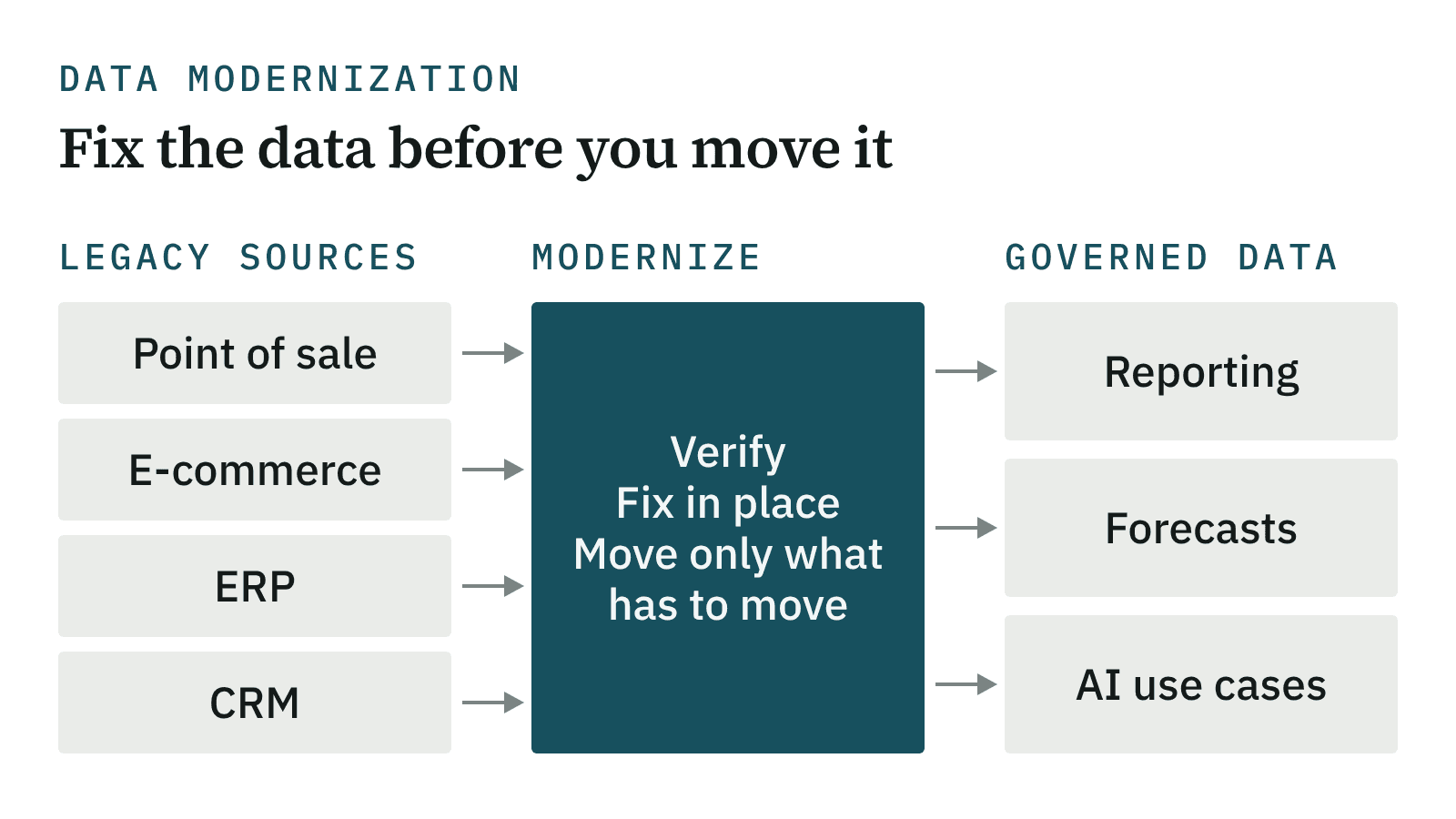
A platform cannot fix the last item on its own. If revenue means one thing in finance and another in your e-commerce platform, the platform produces conflicting recommendations. A single source of truth for core metrics, often kept in a semantic layer that every tool reads from, has to come first.
That foundation is the work of data architecture solutions and data governance services.
Start With the Decisions and the Data Under Them
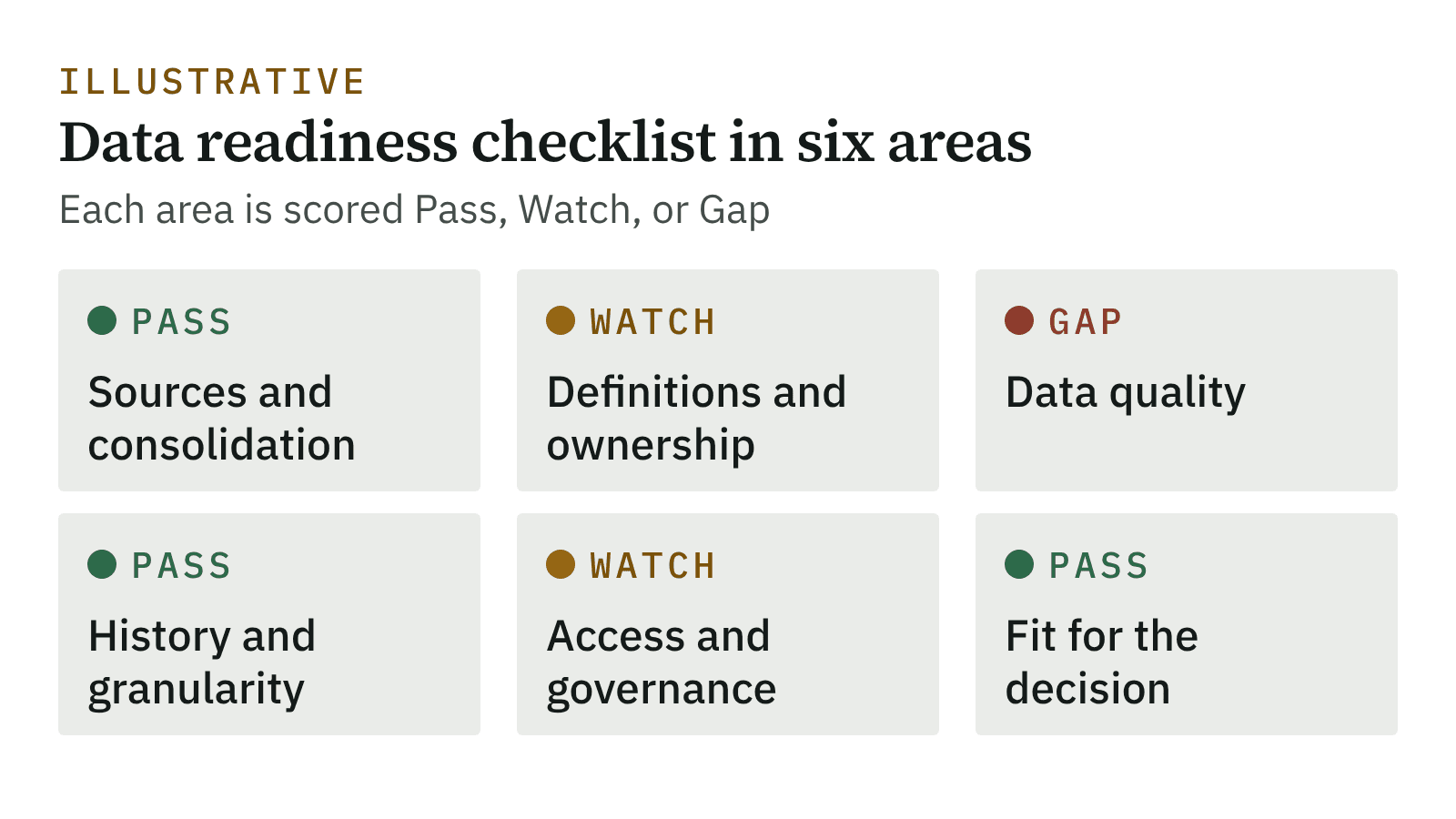
Decision intelligence works when two things are in place: a short list of decisions worth improving, and data that can support them. Check the data before you choose a platform.
That is where we start. We check whether your data supports the decisions you want to improve and show you what to fix first. Then we build the decision models and workflows on the platform you already own, which is the work behind our decision intelligence solutions.
One question decides where to begin: do you have a data warehouse or lakehouse with your key data sources already consolidated into it? If not, or only partly, start with a Data Readiness Assessment. If yes, an AI Readiness Assessment checks whether that foundation holds up for the models and automated decisions you want to run on it.
Final Thought
The value of decision intelligence comes from treating recurring decisions as work that can be designed and then checked against results. Models and AI speed that work up. The data under them determines whether you can trust the result.
Get in touch to start with a Data Readiness or AI Readiness Assessment. We will show you which of your decisions your data can support today and what to fix first.