
Markdown optimization uses demand data to decide when to mark down each product and by how much. The goal is to clear stock by a set date while protecting as much margin as possible.
Without a model, markdown pricing usually follows fixed rules, such as a set percentage off after a set number of weeks, applied to a whole category. Markdown optimization replaces those rules with a separate decision for each product. That decision is based on how the product is selling and how much stock remains.
Zara has tested the approach in its clearance pricing. Felipe Caro and Jérémie Gallien, in a study published in Operations Research, worked with Zara's pricing team to replace a manual markdown process with a sales forecast feeding an optimization model. In a controlled experiment across Zara's Belgian and Irish stores in the 2008 fall-winter season, clearance revenue rose by approximately 6%.
How Does Markdown Optimization Work?
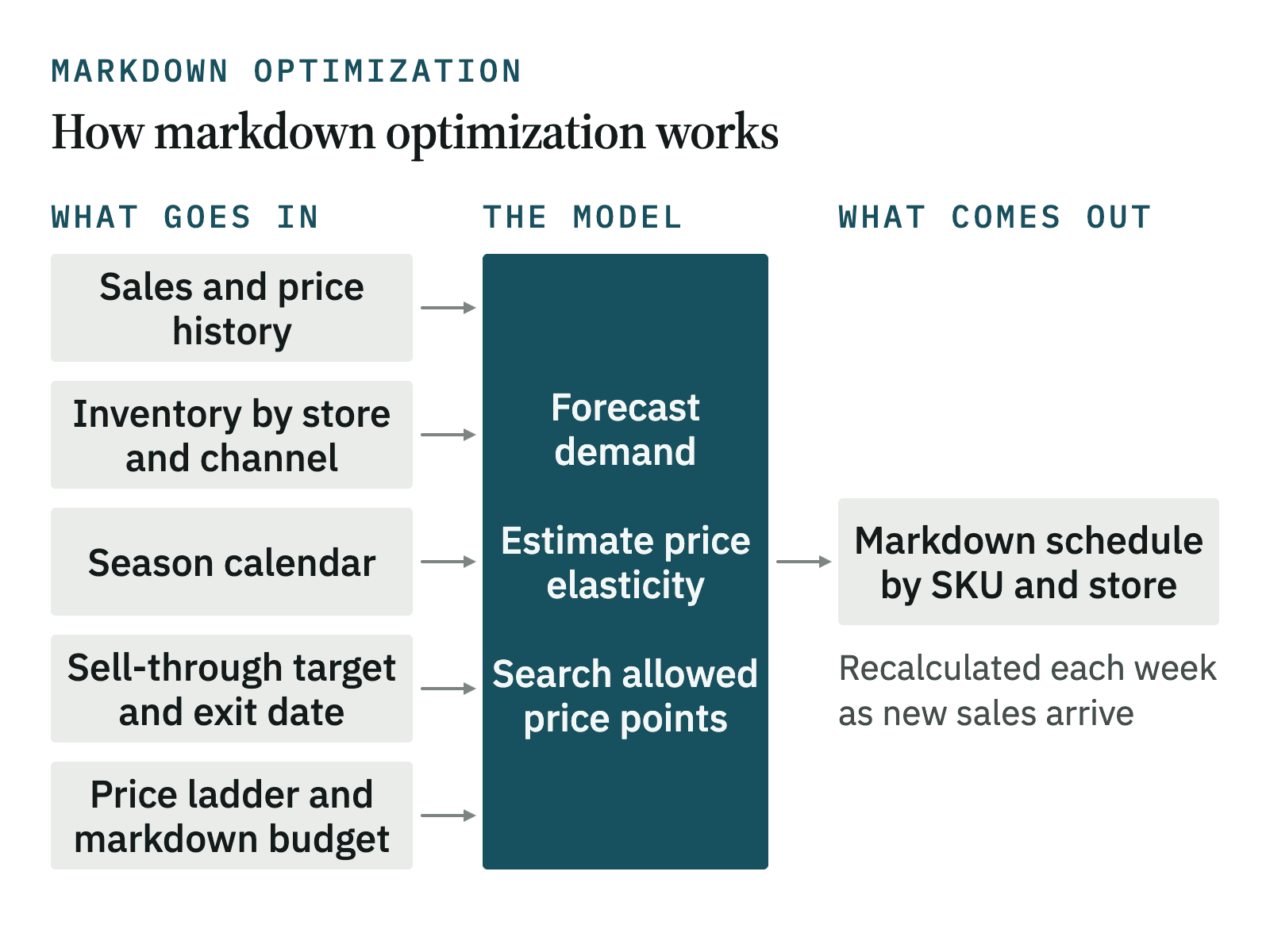
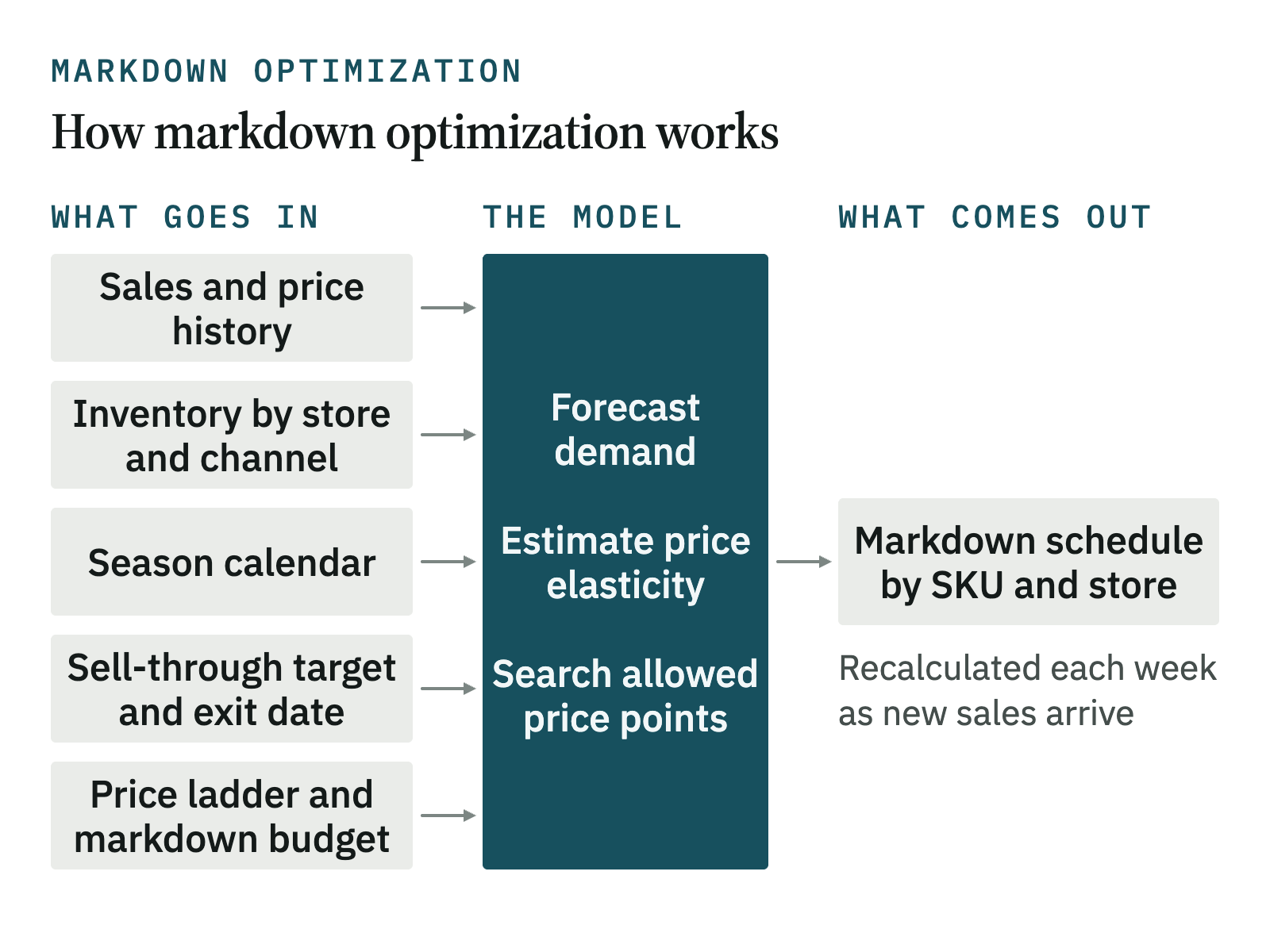
Markdown optimization combines a demand forecast with a set of business constraints, then calculates the price path that produces the most revenue or margin. The model recalculates as each new week of sales arrives.
The inputs are sales and price history by product and location, plus current inventory by store and channel. The season calendar sets the time limit.
From the sales history, the model estimates price elasticity of demand, the percentage change in units sold for each percentage change in price. The model uses that estimate to predict how many additional units a deeper markdown would sell.
Demand forecasting comes first, because every price the model recommends depends on the forecast. The constraints then come from the merchandising plan:
- A sell-through target, the share of units that must sell by a set date.
- An exit date, when the product leaves the store or website.
- A price ladder, the set of price points the retailer allows, such as 20%, 30%, and 50% off.
- A markdown budget is the total margin the retailer is willing to give up across a category.
The model accounts for effects that a fixed rule ignores. Stephen Smith and Dale Achabal, in a study published in Management Science, showed that sales rates depend on the remaining assortment as well as on price and season. A broken assortment, where only a few sizes or colors remain, sells more slowly at any price.
Demand can be estimated with statistical models or with machine learning. A markdown optimization model then searches the allowed price points for the schedule that best meets the targets. It does this product by product, and often store by store, because demand and stock levels differ by location.
Markdown Cadence, Timing, and Depth
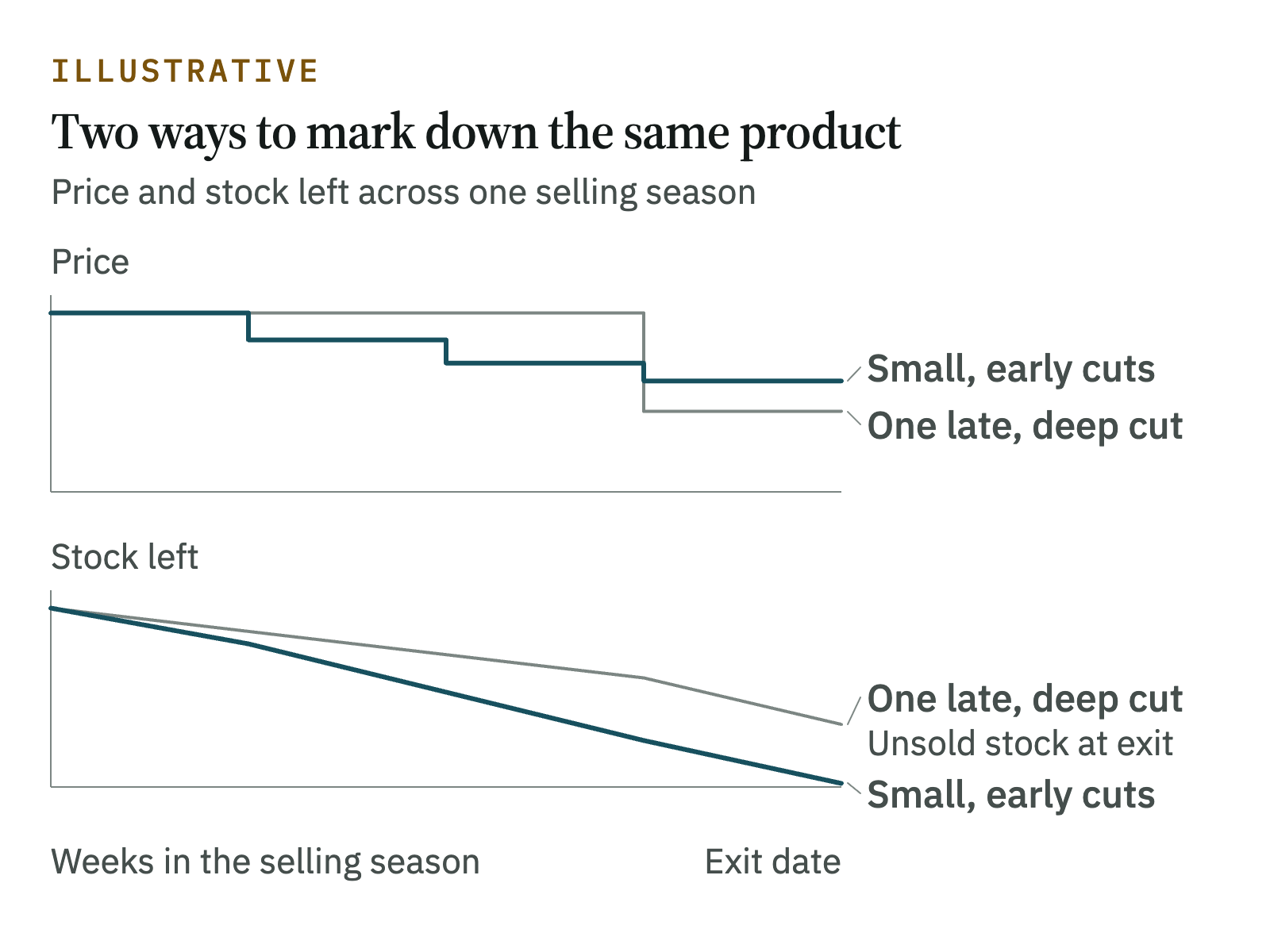
Markdown cadence is the schedule of price steps across a season. It sets when each markdown happens and how deep it goes.
Two studies of apparel retailers reach the same finding on timing. Aliza Heching, Guillermo Gallego, and Garrett van Ryzin analyzed 184 styles from one women's apparel retailer's Spring 1993 season. They found that smaller markdowns taken earlier in the season would have increased revenue significantly.
Gonca Soysal and Lakshman Krishnamurthi, in a study published in Marketing Science, found that strategic customers, shoppers who expect markdowns, delay their purchases to wait for them. At one fashion retailer, those delays left revenue 9% lower than it would have been if shoppers had not waited. The same study found that small, early markdowns produced the highest profit.
A markdown taken before it is needed gives up margin on full-price sales, the units that would have sold without a reduction. Markdown optimization weighs that cost against the risk of unsold stock at the exit date, one product at a time.
Markdown Optimization vs. Dynamic Pricing
Markdown prices only move down, over a fixed season, to sell a fixed quantity of stock. Dynamic pricing moves prices up or down as demand and competitor prices change, as airlines and hotels do.
Both come from revenue management, the practice of using demand forecasts and optimization to price limited inventory. If your products sell year-round, dynamic price optimization is the closer fit. Setting the regular price at the start of the season is a separate decision, covered by price optimization.
How to Build a Retail Markdown Strategy
A retail markdown strategy sets the rules a model works within and names the people who make the final decision. These are the steps:
- Set the targets. Agree on the sell-through target and exit date for each category, and the margin floor below which you would rather hold stock.
- Define the price ladder and markdown budget. Limit markdowns to a few price points that store teams can execute, and cap the total margin each category can give up.
- Choose the markdown cadence. Decide how often prices can change, such as weekly, and how soon after launch the first markdown is allowed.
- Assign markdown management. Name who approves the model's recommendations, who can override them, and how overrides are recorded.
- Measure against full-price sales. Compare results with an estimate of what the same products would have sold without a markdown, since last season's sell-through alone does not show whether a markdown was needed.
During the season, markdown planning becomes a weekly review. Weeks of supply and sell-through rate, by product and location, show which items are behind plan and need a decision.
Markdown Optimization in Retail: Fashion, Grocery, and E-commerce
Fashion and apparel retailers rely heavily on seasonal markdowns because products have short seasons and are often not reordered. Fashion markdown optimization has to account for size curves. The sizes left at the end of a season are often the ones that sell least.
Grocery markdown optimization works on a much shorter cycle. Perishable goods close to their sell-by date need a price that sells them within days. The model weighs lost margin against the cost of waste.
Selling online adds a channel question. E-commerce markdown optimization has to keep store and online prices consistent, unless a difference is deliberate. Online prices can change more often than shelf labels, which allows a faster markdown cadence.
What Markdown Optimization Needs From Your Data
A markdown optimization model needs inventory counts that match what is on the shelf, price history that records every markdown and promotion, and sales by product, store, and week. If inventory accuracy is low, the model plans markdowns for stock that is not there. If promotions are missing from the price history, the model misreads how customers respond to price.
Data that supports a weekly sales report is not automatically good enough for a markdown model. Before you choose markdown optimization software or build a model on the platform you already own, check whether those sources reconcile.
Software suits teams that want a packaged workflow. Building your own model gives you control over it, but it requires data engineering, computing infrastructure, and analysts to maintain it.
Markdown results also feed your customer profitability analysis. Customers who learn to wait for markdowns buy fewer items at full price, which lowers their profitability.
We check the data first.
One question decides where to start: do you have a data warehouse or lakehouse with your key data sources already consolidated into it? If not, or only partly, start with a Data Readiness Assessment. If yes, an AI Readiness Assessment checks whether that foundation holds up for the models and automated decisions you want to run on it.
Either assessment gives you a scored gap map and a roadmap of what to fix first. Once the data holds up, we build markdown optimization solutions on the platform you already own and refresh them each season.
Readiness is where we start. Implementation is where we stay.
Final Thought
Markdown optimization sets the timing and depth of each price reduction, one product at a time, from demand data instead of a calendar. Research on apparel retail favors smaller, earlier markdowns. A model can apply that finding across your whole assortment.
Those recommendations depend on the inventory and price data the model reads, so that data is the place to start.
Get in touch to start with a Data Readiness or AI Readiness Assessment. We will show you what your data can support and what to fix first, then build markdown optimization on the platform you already own.