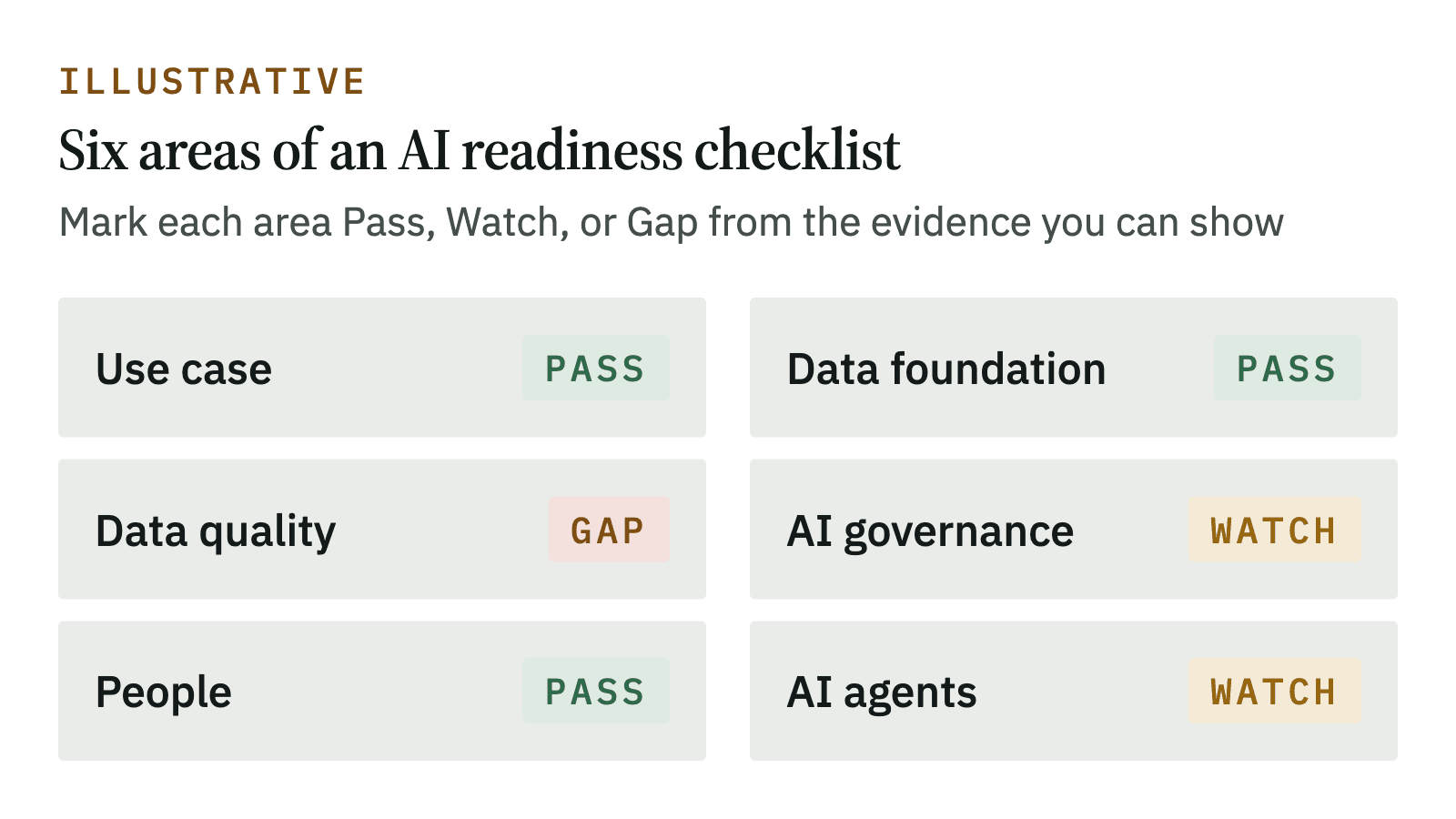
An AI readiness checklist lists the conditions an organization verifies before putting an AI use case into production. It covers the use case, the data, governance, people, and the controls AI agents need.
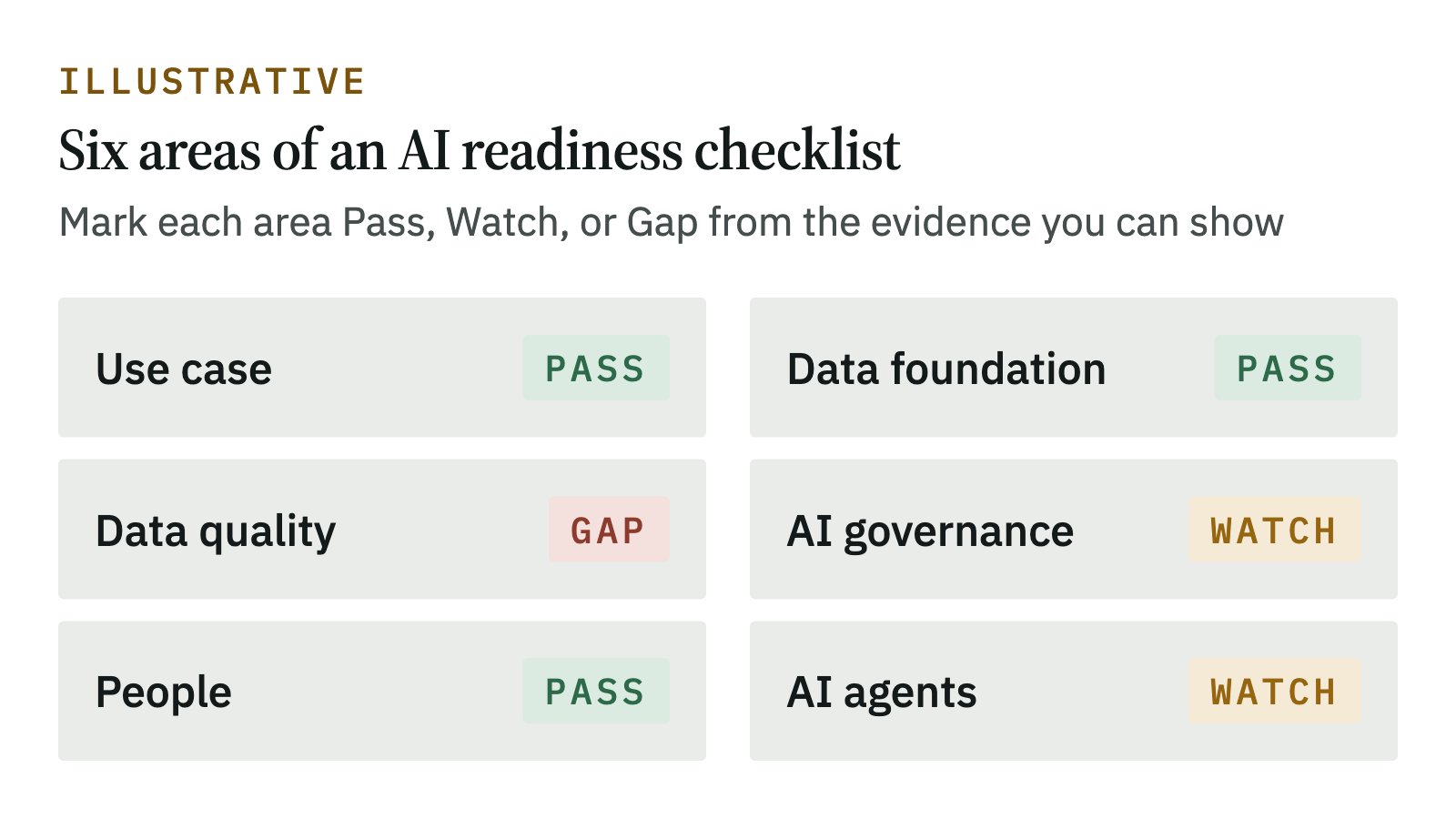
Readiness depends on the use case. The same company can be ready to summarize customer reviews with AI and not ready to let an AI agent change prices. Work through this AI readiness checklist for business teams one use case at a time, and mark each item Pass, Watch, or Gap based on the evidence you can show.
What Is an AI Readiness Checklist?
An AI readiness framework names the areas that decide whether AI will work: strategy, data, technology, governance, people, and culture. An AI readiness checklist turns those areas into individual checks that someone can verify.
An AI readiness assessment framework adds a scoring method and the evidence an independent reviewer collects. With both in place, you can compare results across use cases and over time.
Readiness is also different from maturity. An analytics maturity model rates how advanced your reporting and analysis are overall. A readiness check asks whether one AI use case can run on what you have today.
Data is a common point of uncertainty. In a Gartner survey of 1,203 data management leaders in July 2024, 63% said their organization either does not have the right data management practices for AI or is unsure whether it does. A checklist shows where that uncertainty sits before a project starts.
Is Data That Works for Dashboards Ready for AI?
Data that supports a weekly dashboard is not always ready for AI, because AI places different demands on the same data.
A dashboard reads a few curated tables that analysts check before each report. An AI model or AI agent reads data continuously, often without a person reviewing each input. Many generative AI use cases also draw on unstructured data, meaning emails, documents, and images that do not fit into rows and columns.
Four requirements usually change when the same data has to support AI:
- The data has to be as current as the decision the AI system informs, which can mean hourly feeds instead of a nightly load.
- Each field needs metadata, the definitions and context that tell a model or a person what a value means.
- You need data lineage, a record of where each value came from and how it changed, so you can trace a wrong output back to its source.
- Access controls have to cover the AI system itself, so it can read only the data its use case needs.
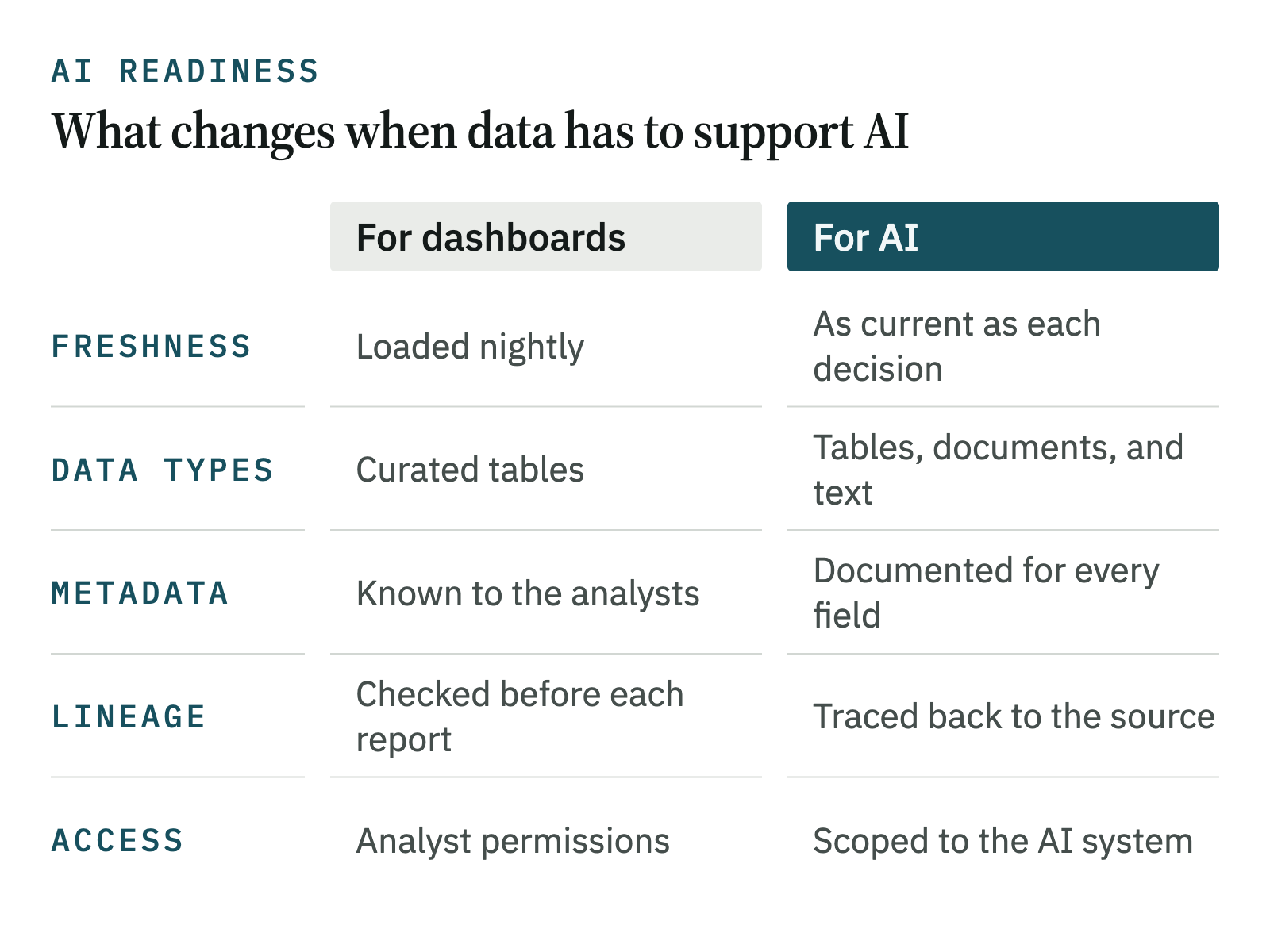
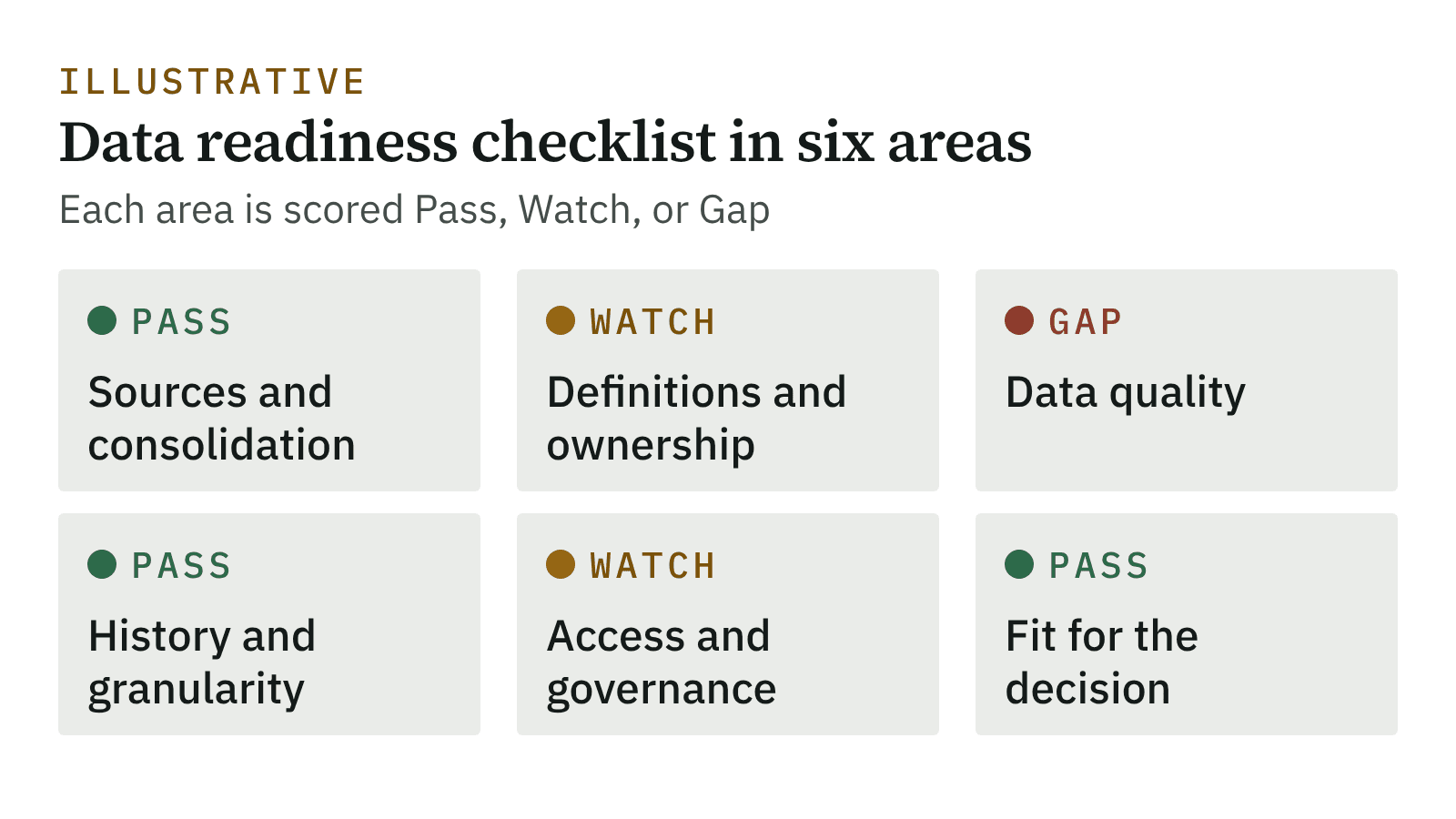
An AI data readiness framework checks for all four. Data that passes is often called AI-ready data: consolidated, documented, traceable, and permissioned. For marketing use cases, our guide to AI-ready marketing data applies the same questions to customer and campaign data.
Full readiness is still uncommon. Cisco's AI Readiness Index 2025, published in October 2025, surveyed 8,000 senior IT and business leaders at organizations with more than 500 employees. It identified about 13% of organizations as Pacesetters, the group most ready for AI, and found they were four times more likely to move AI pilots into production.
The AI Readiness Checklist for Organizations
Each area below lists the checks and the evidence that earns a Pass. If you cannot show the evidence, mark the item Watch or Gap, and note who owns the fix.
Use Case and Business Value
Start with one use case and the decision it should change. A use case tied to a decision, such as which customers to target or how much stock to reorder, is easier to measure than a general goal to "use AI more." Tying analysis to a specific decision is also the starting point of decision intelligence.
If you have several candidates, use case prioritization comes first: rank them by business value and by how ready their data is. A proof of concept, a small experiment that tests whether the idea is technically feasible and worth the investment, should follow these checks.
| Check | Evidence of a Pass |
|---|---|
| The use case names the decision it changes | A one-page brief that names the decision, the users, and the current process |
| Success is measurable | A baseline metric and a target, agreed by the business owner |
| Someone owns the outcome | A named business owner with budget for the work after the proof of concept |
Data Foundation
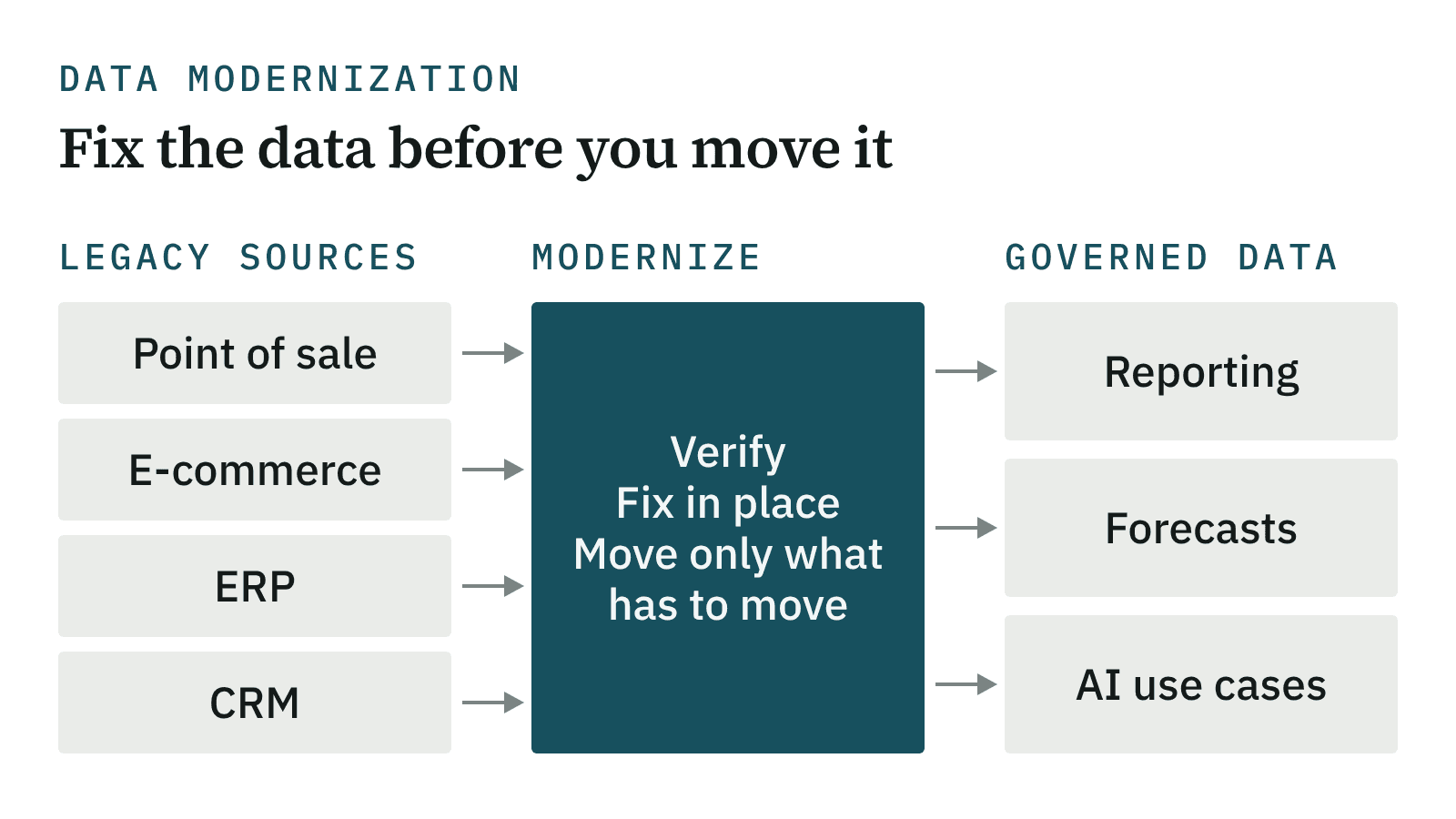
This check asks whether the AI system has one reliable place to read from. If your key sources sit in separate systems with no consolidated warehouse or lakehouse, building that foundation is the first piece of work. For customer use cases, the foundation also needs identity resolution, which matches records for the same customer across systems.
| Check | Evidence of a Pass |
|---|---|
| Key sources are consolidated | The use case's source systems load into one warehouse or lakehouse on a schedule you can show |
| Data is fresh enough | Load times that match how often the AI system makes decisions |
| Access is scoped | Access controls that give the AI system only the tables and fields its use case needs |
Data Quality and Governance
Data quality has to be measured on the fields the use case reads, because an average quality score can hide a weak field that the model depends on. Data governance then sets who defines each field, who can change it, and who is accountable when it is wrong. Those decisions are usually recorded in a written data governance framework.
| Check | Evidence of a Pass |
|---|---|
| Quality is measured where it matters | Completeness and accuracy results for each field the use case reads, with agreed thresholds |
| Definitions are documented | A data catalog or glossary entry for each field, with a named owner |
| Lineage is traceable | A record that traces each field from its source system to the table the AI system reads |
AI Governance and Risk
AI governance covers decisions that data governance does not: which AI uses are allowed, who approves them, and how outputs are checked. A common reference is the AI Risk Management Framework (AI RMF) from the National Institute of Standards and Technology (NIST), voluntary guidance built around four functions: govern, map, measure, and manage. Your own AI governance framework sets out how those functions apply to your use cases.
| Check | Evidence of a Pass |
|---|---|
| AI uses are listed | An inventory of the AI systems in use, including tools staff use on their own |
| Risk is reviewed before launch | A completed risk review for the use case that covers privacy, bias, and what happens when an output is wrong |
| Sensitive data is protected | Rules that keep personal and confidential data out of prompts and training data unless someone has approved it |
People and Operating Model
An AI adoption readiness framework also has to cover the people who use the output and the process around it. Users need enough AI literacy to know when to trust an output and when to question it. Plan change management, the work of moving people to the new process, with its own budget and owner.
| Check | Evidence of a Pass |
|---|---|
| Users understand the output | AI literacy training completed by the people who act on the output |
| The process is redesigned | A documented process that shows where the AI output enters and who signs off |
| Someone runs it after launch | A named team responsible for monitoring and retraining after the pilot |
AI Agent Readiness Checklist
AI agents need a further set of checks because they take actions, such as updating a record or launching a campaign. Cisco's AI Readiness Index found that 83% of organizations plan to deploy AI agents. An AI agent readiness checklist covers what each agent can see, what it can change, and how a person can stop it.
The data checks above still apply, because an agent can only act on what it is allowed to read. Human oversight means a person approves high-impact actions before they run.
| Check | Evidence of a Pass |
|---|---|
| Access is scoped | Permissions that limit each agent to the data and tools its task needs |
| Actions that change data need approval | Approval gates on any action that writes, deletes, or sends, with a named approver |
| Every action is logged | A log of what each agent read and changed, kept for review |
| The agent can be stopped | A named owner and a tested way to pause the agent |
An AI agent production readiness checklist adds testing before launch: run the agent on past cases and compare its actions with what your team decided. The rules for which agents may act, and on what, belong in your AI agent governance policy. Running several agents, models, and tools under one set of controls is called AI orchestration, which we cover on our AI orchestration solutions page.
How to Score Your Results: Pass, Watch, or Gap
Mark each check with one of three results. Pass means the evidence exists and someone can show it today. Watch means the work is in place but partial, undocumented, or unowned, and Gap means it is missing.
An AI readiness assessment checklist only works when every mark has evidence behind it. Without evidence, a yes records what someone believes about the data, which may differ from what the data shows.
The checklist on this page is not an AI readiness audit checklist. An audit tests compliance against a fixed standard, while a readiness check asks whether one use case can run on what you have and what to fix first.
Score each use case separately, and do not add the marks into a total. A strong average can hide a single Gap that stops the project, so any Gap in the data foundation or data quality checks comes first.
Run the checklist again at each stage. Australia's Digital Transformation Agency (DTA) takes this approach in its guidance for scaling AI from proof of concept, which sets separate checks for government agencies before a proof of concept, after it, before scaling, during a pilot, and after scaling. An AI readiness checklist for enterprises with several use cases in progress works the same way, with stronger evidence required at each stage.
What to Fix First
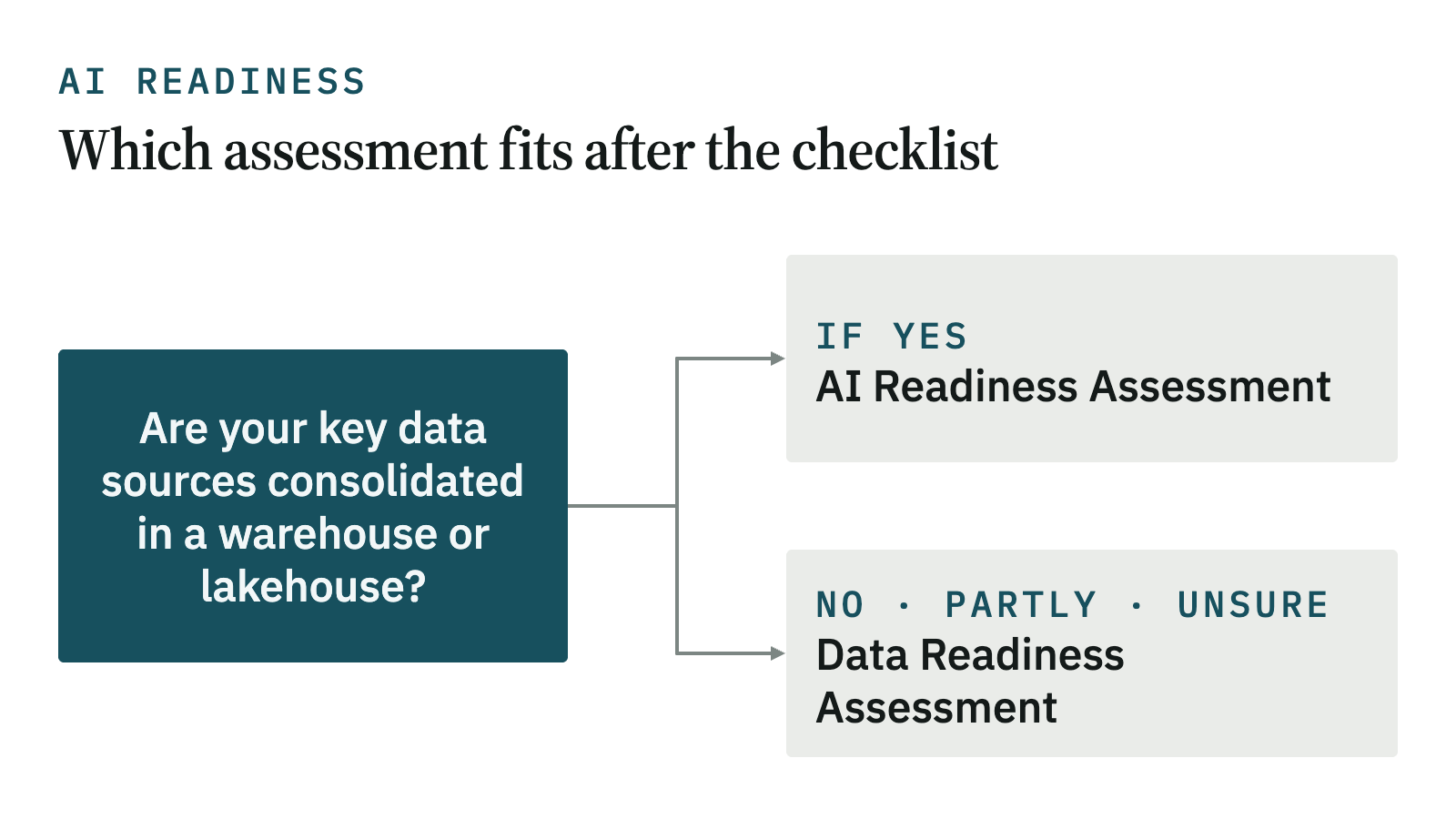
Your AI readiness checklist results point to one of two starting points. Ask one question: Do you have a data warehouse or lakehouse with your key data sources already consolidated into it?
If the answer is no, partly, or "we think so," fix the data first. Start with our data readiness checklist, and consider a Data Readiness Assessment, which checks whether your data can support confident decisions before any AI work begins.
If the answer is yes, the foundation exists, and an AI Readiness Assessment checks whether it can support AI.
AI readiness assessment framework consultants typically do one of two jobs: they assess your readiness, or they build what comes next. We do both. We verify every phase from data foundations to AI orchestration with evidence, give you a gap map scored from 0 to 100 per phase, and sequence the roadmap by business impact.
Every score comes with the evidence behind it. Then we stay to implement the roadmap on the platform you already own, starting with data engineering solutions where the foundation needs work.
Final Thought
The value of an AI readiness checklist depends on the evidence behind each mark. Its purpose is to find the Gap that would stop your first use case before you spend on models or agents.
If your data is not consolidated yet, start with a Data Readiness Assessment. If it is, an AI Readiness Assessment shows what to fix before your first agent goes live on the platform you already own. Get in touch to find out which assessment fits your data.