
Retail promotion optimization uses sales data and demand models to decide which items to promote, how deep to discount them, and when to run each promotion. The aim is to increase the profit generated by the promotional calendar, which is a different target from increasing unit sales.
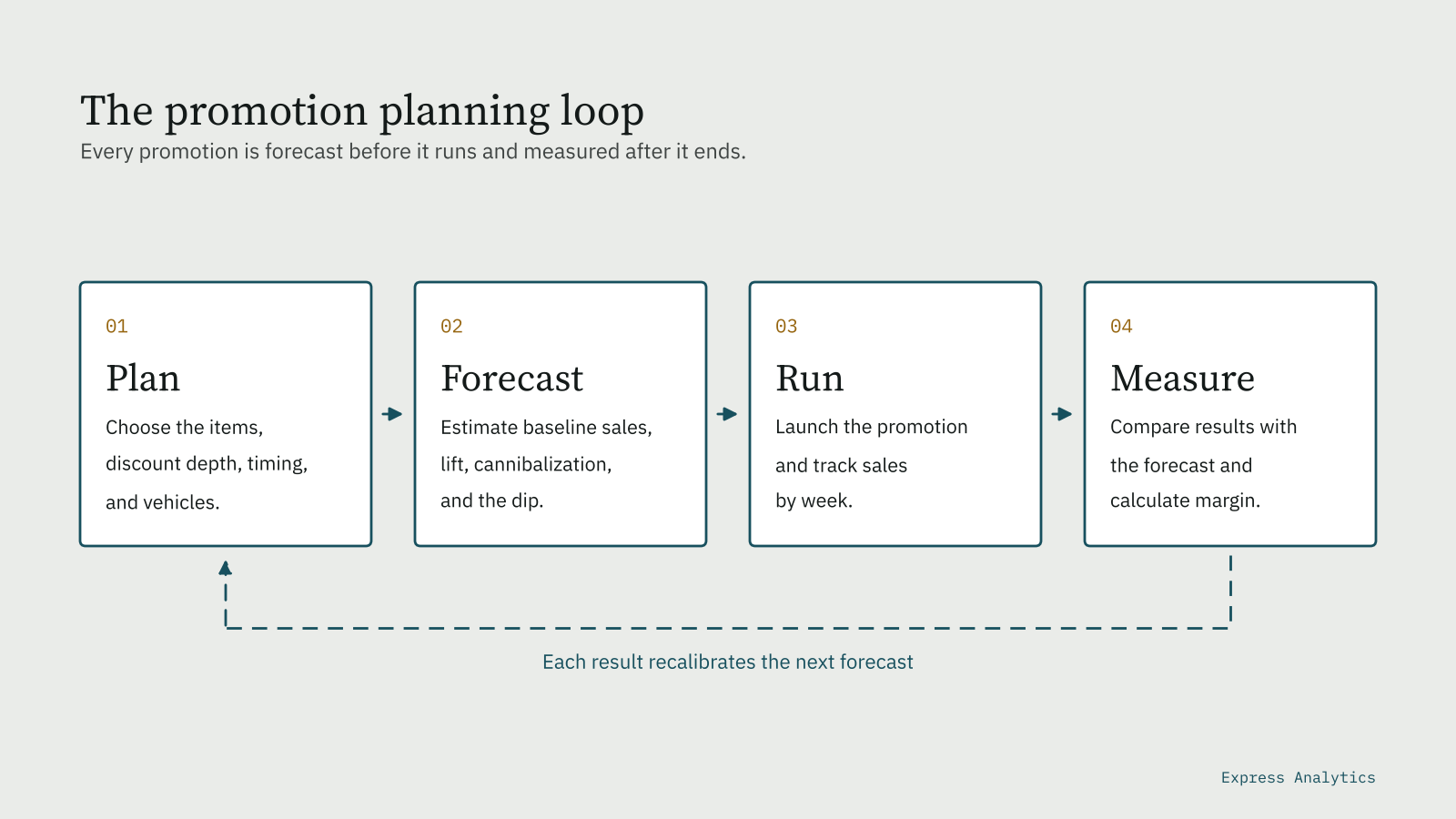
Promotion optimization in retail changes how weekly promotions are chosen. Each one is forecast before launch and measured after it ends, so your next plan starts from evidence rather than from last year's calendar.
What Is Retail Promotion Optimization?
Retail promotion optimization treats the promotional calendar as a set of decisions that can be modeled. For each item and week, the retailer decides whether to promote, which discount and mechanic to use, and which vehicle (a flyer, an email, or an end-cap display) will carry the offer.
Traditional promotion planning makes those decisions in spreadsheets, and retail promotion management tools record and execute the plan. Promo optimization, also called promotional optimization, adds a step before execution. A demand model forecasts each option, and an optimization method selects the plan with the highest expected profit.
The decisions are subject to business rules, such as a limit on how often an item can be promoted. A 2021 study in Management Science by Cohen, Kalas, and Perakis builds these rules into the optimization as constraints, so the recommended plan is one the retailer can run.
Retail Promotion Optimization vs. Trade Promotion Optimization
The two terms describe the same promotions from different sides. Retail promotion optimization is the retailer's decision about what to offer shoppers. Trade promotion optimization is the manufacturer's decision about how much funding to give retailers for those promotions, and it is a central question for CPG brands.
Your retail promotion strategy sets the mix of mass promotions, which apply to every shopper, and targeted offers based on loyalty data. It also decides which items stay off promotion. Key value items, the products shoppers use to judge whether your prices are fair, often need different rules from the rest of the range.
A markdown is different: it is a permanent price cut that clears seasonal or excess stock, and markdown optimization sets its timing and depth separately.
How Promotion Optimization Works
Retail promotion optimization has two parts. A demand model estimates how sales of each item respond to promotions, and an optimizer uses that model to choose the plan.
Baseline Sales, Lift, and Incremental Sales
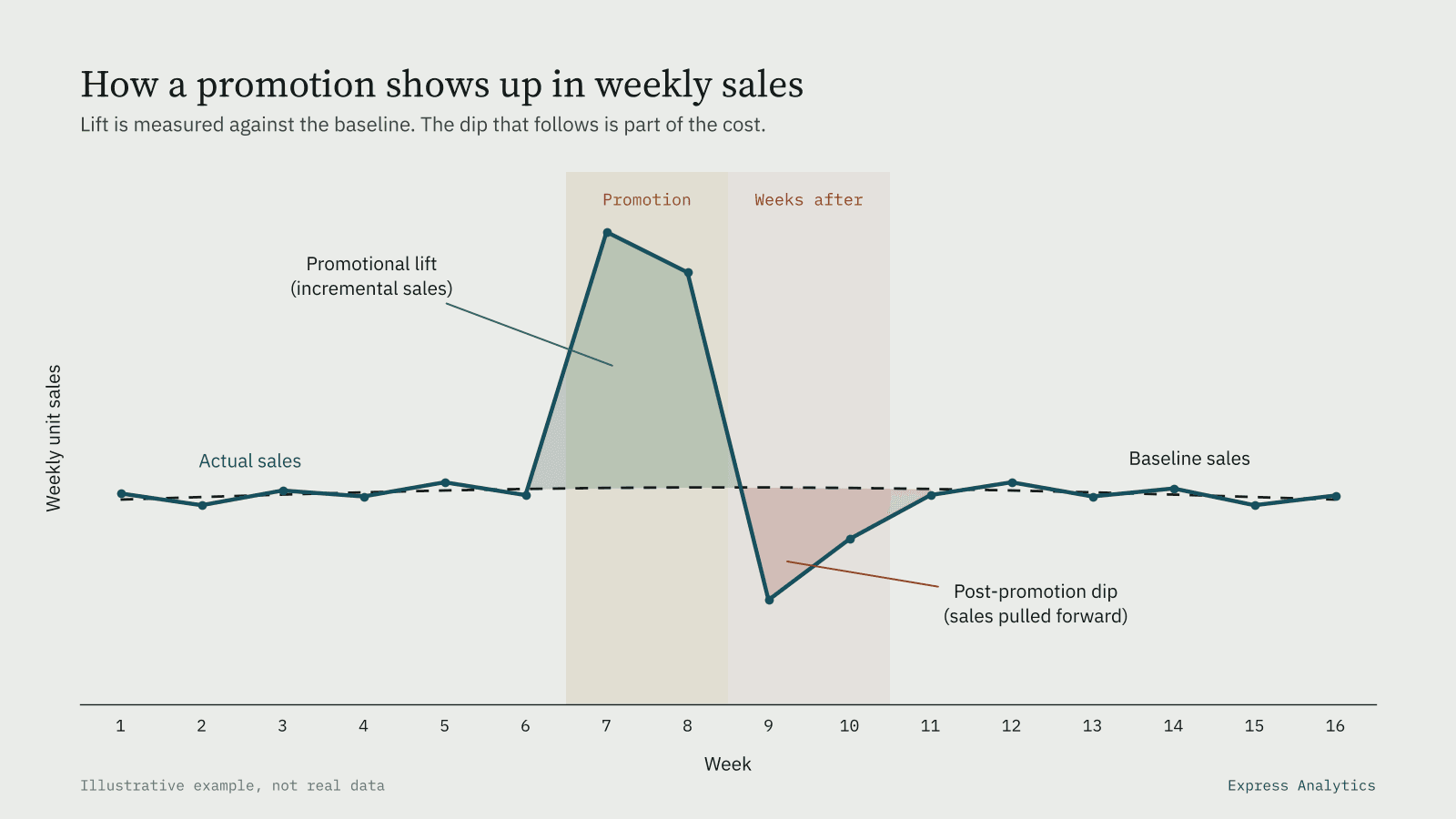
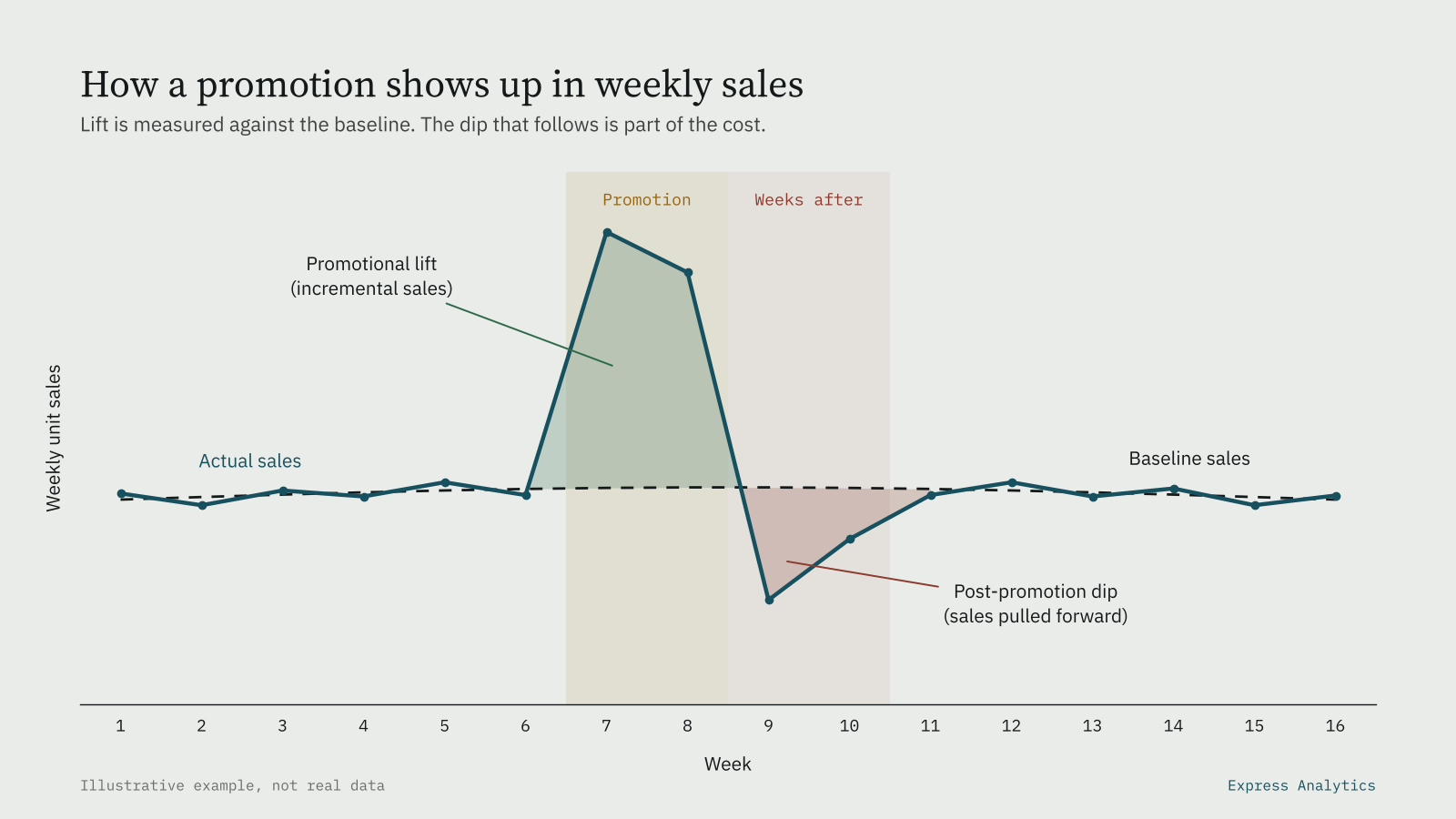
Baseline sales are the sales an item would generate in a given week without a promotion.
Subtracting baseline sales from promoted sales provides the incremental sales the promotion created.
Promotional lift expresses that difference as a percentage of the baseline.
Estimating the baseline is the difficult part because it depends on seasonality, regular price, distribution, and recent trends. Promotion forecasting adds promotion variables to the models used in demand forecasting.
The model also estimates promotional elasticity, which is how much demand rises for each step in discount depth. It is linked with the price elasticity of demand, the usual calculation of how quantity demanded reacts to a price change.
Cannibalization, Halo, and the Post-Promotion Dip
A promotion affects more than the promoted item. Promotional cannibalization happens when shoppers switch to the discounted item from its substitute goods, the similar items they would otherwise have bought. Part of the lift is then taken from the rest of the category.
The halo effect retail teams look for works in the opposite direction. A discount on pasta can raise sales of pasta sauce, one of its complementary goods.
Shoppers also stockpile during a deep discount. This creates a pull-forward effect, in which sales that would have happened in later weeks happen during the promotion instead. The weeks after the promotion then show a post-promotion dip.
Once cannibalization and the dip are counted, a promotion with a strong lift can still lose money. The 2021 Management Science study includes both effects in its demand models.
Optimizing the Plan Under Business Rules
The optimizer searches the combinations of items, discounts, weeks, and vehicles for the plan with the highest expected profit within the business rules. Promotion plan optimization works on the whole calendar rather than one event at a time. For a category with hundreds of items, that search is too large to run by hand.
AI promotion optimization usually refers to machine learning in the forecasting step, where it can capture more variables and interactions in the demand estimate.
The same model supports what-if analysis before a plan goes live. You can compare a 25% discount with a 15% discount and see the forecast effect on units and margin. Price and promotion optimization often run together at this stage, because the regular price set by price optimization is the starting point for every discount.
A 2017 study in Operations Research by Cohen, Leung, Panchamgam, Perakis, and Smith tested an optimization model on sales data from a grocery retailer. The optimized promotion schedule could increase profit by about 3%, or by about 5% with some business rules relaxed.
Measuring Promotion Effectiveness
Promotion effectiveness is measured after each event by comparing actual results with the forecast and the baseline. This post-event promotion analysis shows whether the lift came from new demand or from cannibalization and pull-forward sales.
Retail promotion analytics should report margin as well as revenue. Promotion ROI compares the incremental gross margin a promotion generated with its full cost, which includes the discount on baseline units as well as vehicle and display costs.
Where a result is unexpected, incrementality testing compares stores that ran the promotion with matched stores that did not. Those results feed the next retail promotion optimization cycle, and promotional effectiveness improves as each forecast is checked against what happened.
What Retail Promotion Optimization Needs From Your Data
Retail promotion optimization is only as accurate as its historical data. You need item-level POS data covering several seasons, with regular prices, promotional prices, and the promotional calendar recorded consistently.
Margin measurement and targeting require cost, loyalty, and inventory data.
In most retailers, those sources sit in different systems. If your promotional calendar does not reconcile with your POS data, the model cannot tell which weeks were promoted. Retail promotion planning depends on consolidating that data first.
Promotion decisions are guided by the same data as customer profitability analysis and other margin-associated decisions. We applied dynamic price optimization to help a retail company win the Amazon Buy Box.
One question decides where to start: do you have a data warehouse or lakehouse with your key data sources already consolidated into it? If not, or only partly, start with a Data Readiness Assessment. If yes, an AI Readiness Assessment checks whether that foundation can support the forecasts and automated decisions you want to run on it.
Final Thought
Most retailers judge promotions by the lift they create. The figure that decides whether a promotion was worth running is the margin left after cannibalization, the post-promotion dip, and the discount on sales you would have made anyway.
Retail promotion optimization lets you estimate that figure before the promotion runs.
Get in touch to start with a data readiness or AI readiness assessment. We will show you what your data can support and what to fix first, then build your retail promotion optimization models on the platform you already own.