Last-click gives all the credit to the final touch. Multi-touch spreads it across the journey. Learn the main models, what each one is good at, and how to pick one.
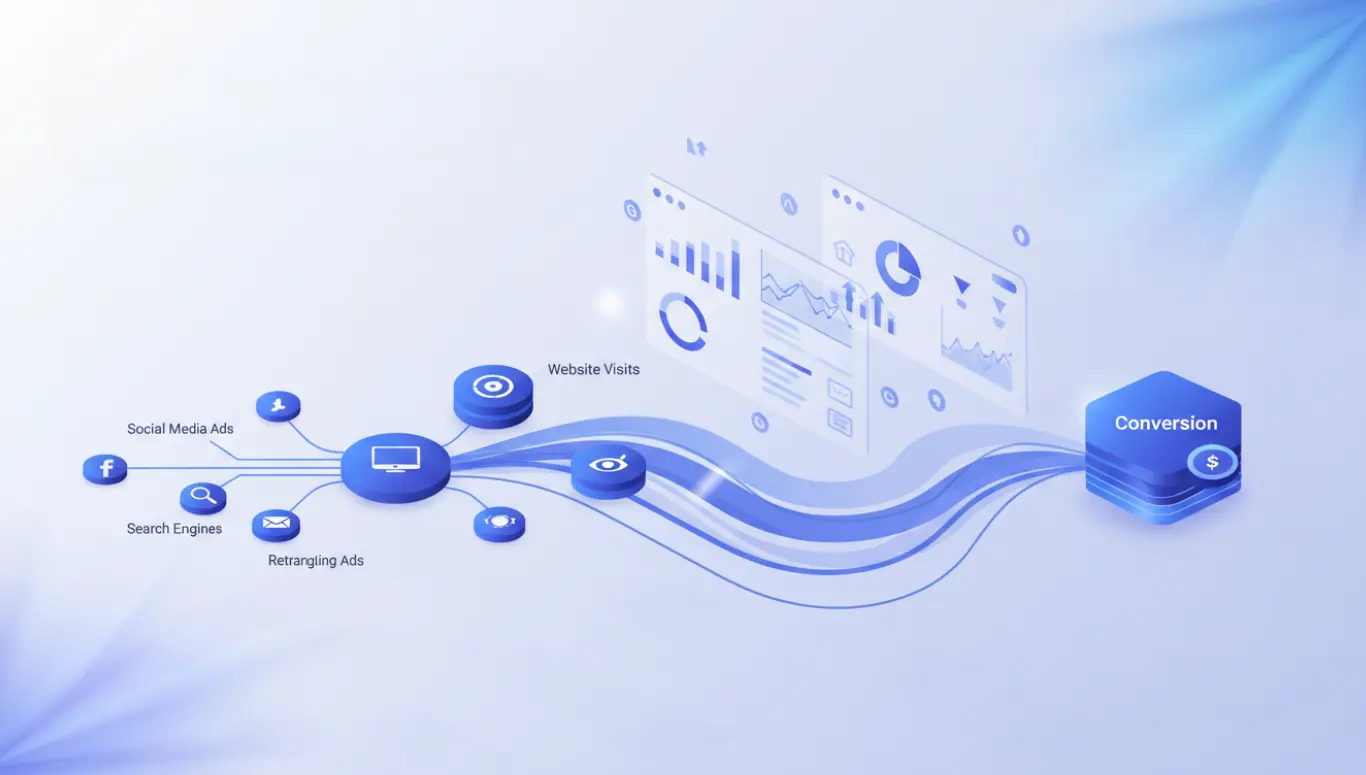
Attribution decides which channels get credit for a conversion, and credit decides budget. Pick the wrong model and you will keep funding the channel that closes deals while starving the ones that start them.
- Last-click: 100% of the credit goes to the final touch. Simple, but it overvalues branded search and retargeting.
First-click: 100% goes to the first touch. Useful for judging awareness, blind to everything after. Linear: credit is split evenly across every touch. Fair, but it treats a passing impression like a demo request. Time-decay: touches closer to conversion earn more. Good for short, sales-led cycles. Position-based (U-shaped): 40% to the first touch, 40% to the last, 20% shared across the middle. A sensible default for B2B. Data-driven: a model (Shapley values or Markov chains) learns each touch's contribution from your own paths. The most accurate option, but it needs volume. - Under ~300 conversions a month? Use position-based. Data-driven models will be noisy.
Long B2B cycle with many stakeholders? Position-based or data-driven, measured at the account level. Short e-commerce cycle? Time-decay or data-driven. - Comparing channels across models. Pick one model per report.
Ignoring offline and dark-social touches. Every attribution model is limited by what you track. Treating attribution as causal. To prove that a channel actually caused lift, pair attribution with incrementality tests. No model is true; some are useful. Start with position-based, add holdout tests to check it, and move to data-driven once you have the volume to support it.