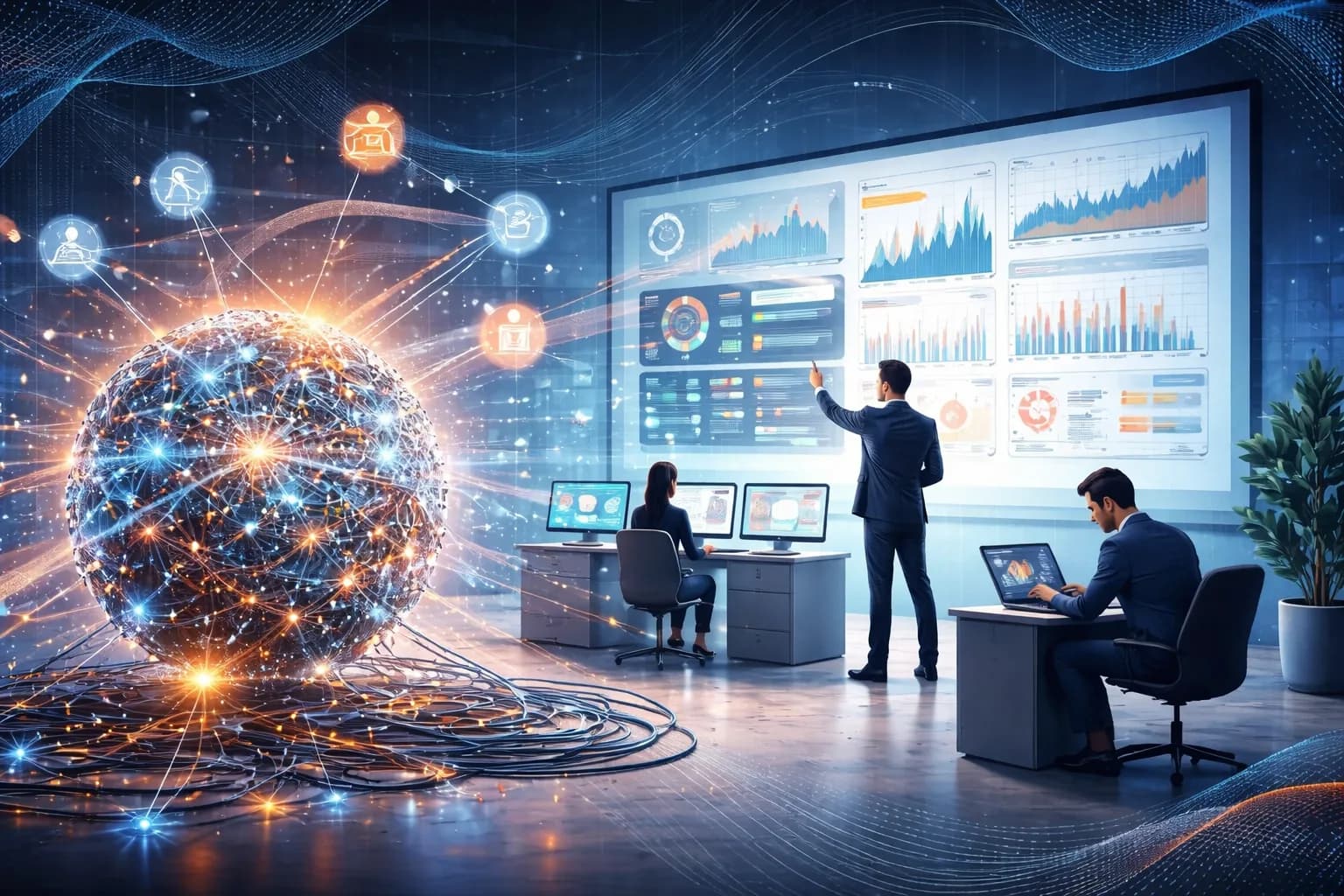
In business, you need to know how your business is doing day-to-day. To understand your company's health, many turn to Data-Driven, intelligent operations that help companies across many industries become more effective and efficient.
As the amount of data generated by sources inside and outside the company increases, as software tools are readily available to process that data immediately, and as competition in every sector intensifies, intelligent business operations are becoming increasingly practical.
Systems set up for complex event processing monitor the streams of data flowing through an organization, and, based on business rules, investigate relationships between individual events that may signal the occurrence of some larger event.
What is Event-Driven Analytics?
Thus, event-driven analytics is the form of analytics performed in response to a specific event. This term often refers to analytics performed after a particular action is taken.
As data streams arrive in real-time, companies are using complex event processing (to process data in real-time and extract consumer data) to predict customer behavior and recommend products and services to clients to motivate real-time decisions.
What is Event-based Analytics?
Events are mostly interactions a user has with any form of content. In a broader context, event analytics encompasses real-time analytics and the processing of historical event data.
Analytics in this sense help provide insights into what the events mean and how each event is treated. An event in a program can generate data that can be compiled to capture detailed information about how users interact with it.
Then, it could be a customer selecting a product or service for payment, a customer with a more negative sentiment than usual that a business needs to address quickly, or some misinformation that a company wants to catch before it impacts its stock price.
Events can be generated by users, such as keyboard strokes or mouse clicks, or by the IT system itself, such as program errors.
A user-generated event can be a newsletter sign-up, a product purchase, a click-through to a link, and so on.
The goal of event data management is to track all of that data, analyze it, and turn it into dashboards or reports that your enterprise users can use to make decisions.
In short, event data management is about capturing people's actions in a business through their interactions with software.
Here are some ideas to keep in mind when you are developing your own event data management strategies:
Start by setting up an Event Tracking System (ETS) for events within your environment that don't require any hardware or software purchases, and will make life easier for you down the road.
Start simple. Capture events with a set of rules, or a form template, and track a user's input as a string of text. Do not capture data as it is entered; instead, capture events as you define them.
Struggling to make sense of your data? See how event-driven analytics can help >>>> How it works
The more flexible the system, the better. A system may include features such as capturing images from forms, using JavaScript code on websites to integrate functionality into your programs, or using external tools you regularly use.
Events are the purpose of an ETS; they are not an end in themselves. A best practice for creating an event tracking system is first to define the event types that most users will enter into your system, then determine the more complex requirements for advanced tasks.
The larger the volume of events you capture, the more likely you are to want to consider distributing the data.
Benefits of Event-driven Analytics
Better focus on value creation by looking at higher levels of detail. An event-based approach places much greater emphasis than a time-based one, ignoring other components and viewing only what occurred at a given time within a time frame.
Easy to expand. Event-driven solutions make it easy to expand by adding new data sources or migrating data from existing ones.
Real-time correlation with external systems enables better integration and reporting, and supports real-time dashboards, alerts, and reports.
Event-based analytics helps build a data warehouse in near real-time to support your real-time analytics needs. This means even as your business transactions are happening, your warehouse is being developed, too.
Use Cases of Event-based Analytics
Increasingly, companies are leveraging event-driven analytics to identify event patterns and their impact on business trends and key performance indicators.
Many companies are tracking and acting on this information using complex event processing to keep up with competitors, or, in some cases, to identify and resolve customer or operational issues as soon as possible.
Some real-world uses for event-driven analytics are:
In cybersecurity, event-based analytics is used to detect zero-day attacks.
An event-driven system is set up to capture data as it arrives and processes it in real-time. These can be instances of specific attacks, such as DDoS and botnet attacks.
In telecommunications, event-driven analytics is used to build converged network services that deliver a highly efficient customer experience.
For an example of event-driven marketing, an end-to-end SIP call analysis service can detect if a specific call was dropped due to an IP conflict between two endpoints, or a particular quality of voice was not achieved after calling into multiple numbers from one place, or if certain countries/cities have higher call drops than other countries/cities.
Struggling to make sense of your data? See how event-driven analytics can help >>>> How it works
Other examples of event-based analytics include high-capacity IP video calls, IP telephony-to-IP video calls, and the like.
Event-driven analytics is also widely used in stock markets. It is also used in credit card fraud detection.
Conclusion
Business success has increased, and the number of operations that are both intelligent and efficient is expanding.
Companies are increasingly able to use data quickly to make decisions that are both effective and practical. Event-driven analytics is helping companies increase efficiency.