
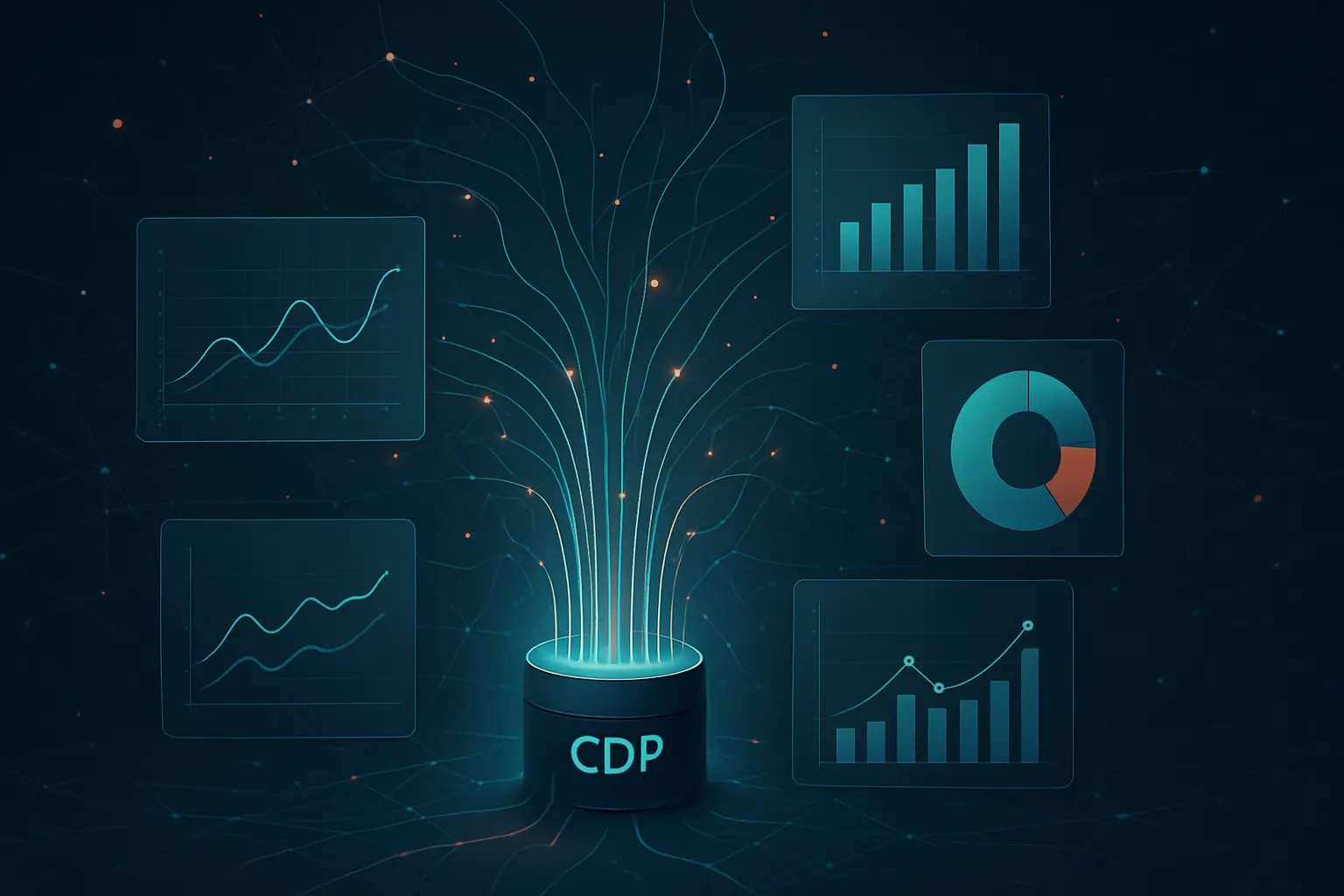
A customer data platform (CDP) is a software system that not only collates customer data from disparate sources but also provides insights to help improve your business.
It includes maintaining data warehouses, building customer profiles, maintaining activity logs, and developing profiling models. Know how to get actionable insights from customer data platforms.
The ideal customer data platform (CDP) offers all of these benefits: it automates data aggregation, provides insights into the user's business, and helps grow the customer base.
One of the many functions of a CDP is to help businesses determine which marketing methods are most effective for customer retention.
With global marketing budgets under pressure because of the COVID-19 pandemic, it has become imperative for marketing divisions to be even more focused on their campaigns. Therefore, obtaining a CDP is even more essential today.
In this post, we will focus on how you can actually use data-based insights from a CDP to improve operations, generate new revenue, enhance customer relations, and better product development, all of which will eventually lead to business growth.
What is A CDP?
A customer data platform is a system that captures and stores customer data. It analyzes all data across channels and devices, offline and online, and then uses the insights to create personalized experiences for each customer.
In the traditional model, a customer data platform is implemented as a "SaaS" solution that runs on-premises and provides centralized management, reporting, analytics, and automated marketing for all customer interactions. But the customer data platform can be implemented not only on-premises but also in the cloud.
In addition to its native support for both MySQL and PostgreSQL, it also supports SQL Server.
A CDP is an interactive, predictive analytics system that collects data from multiple sources and stores it in a centralized database.
A customer data platform is a type of software that combines CRM and marketing automation.
The term "Customer Data Platform" has been used to refer to both customer relationship management (CRM) and marketing automation software.
The terms CRM and Marketing Automation are sometimes used interchangeably, but remember, customers are different from clients in that they are not necessarily repeat business for the organizations that use them.
According to Gartner, there are four types of CDP: Marketing Cloud, Smart Hub, Marketing Data Integration, and CDP Engines and Toolkits.
CDP Simplifies Marketing By Providing Insights On Each Prospect
Marketing budgets have fallen to their lowest recorded level, dropping to 6.4 percent of company revenue in 2021 from 11 percent in 2020, according to Gartner, Inc. In the annual Gartner CMO Spend Survey, Gartner surveyed 400 CMOs and marketing leaders in North America, the UK, France, and Germany from March 2021 through May 2021, tracking the critical areas marketers are investing in and where cuts are being made from people, programs, and technologies.
Clearly, with fewer funds, marketing divisions need to be even more focused in their campaigns to hit the right customer profile with the right message. A CDP can be invaluable here.
A customer data platform is a solution that simplifies the marketing process by providing actionable insights on each prospect. These come from data collected from various sources and provide an in-depth analysis of a prospect's values, attitudes, needs, and preferences.
A CDP provides a complete profile of each customer, enabling marketers to improve marketing campaigns by identifying the right prospects, segmenting them into target groups, and optimizing messages to reach the correct number of customers.
Data from customer interactions are primarily collected in "data silos." Modern marketing relies heavily on customer data platforms to break down these silos. The information age is not just about the digital world; it also involves using data from customer interactions to create better service and more effective marketing.
Customer Dashboards: Which Metrics To Track
A CDP comes with what's called a "customer dashboard". This tool allows a company to visualize customer performance, optimize customer service, and build customer loyalty. A critical component of any customer dashboard is the metrics that are used to measure performance and progress.
A customer data platform provides many metrics that can be helpful to marketing teams. These include:
- The number of contacts
Customer data platforms are used to understand customer wants, measure the effectiveness of marketing campaigns, and provide actionable insights into customer behavior. Many companies use these platforms to gather and analyze data on their customers to improve marketing and sales efforts.
Use AI to Understand Your Customers Better >>>>> Learn More
Enterprises use CDPs to boost their business by better understanding their customers. Companies such as Google and Facebook use customer data platforms to understand better their customers, which can lead to more effective marketing strategies and increased sales.
How To Use Actionable Insights From a Customer Data Platform
With customer data platforms, businesses can collect, store, manage, and analyze data from multiple sources in one place. This includes customer-facing data like purchase history, customer service data, and social media activity.
The process of data collection, measurement, and discovery is called data-driven management. It refers to the process of collecting relevant data and using it to make decisions.
A robust customer data platform like Express Analytics' Oyster includes the following business intelligence moving parts:
- Data science: Knowledge discovery in databases
Using Insights To Understand Customers
By now, it may have become pretty apparent that it is not enough to store all your customer data in one place. That's the first half of a CDP's functions. The other "critical" half is to use customer data analytics, which means using this data to understand how customers use a product or service, what they like and don't like about it, and how their behavior can be influenced.
Using CDPs, companies can track and analyze data from sources such as website visits, mobile app use, social media interactions, and offline purchases to better understand the customer journey.
Data can then be used to identify friction points that may lead to churn among customers. By tracking and analyzing website usage, businesses can improve the customer experience by better understanding the customer journey.
Analyzing mobile app users can help companies identify friction points and improve customer experience.
Cost optimization is an important business initiative. With so many companies competing for customers, it is vital to have an edge over the competition. One way to be competitive is to use customer data to deliver actionable insights.
Increased competition has put pressure on companies to ensure a level of customer service that keeps customers coming back and encourages them to recommend the company to others.
Analyzing customer data can help companies improve customer service and reduce costs.
Using a CDP, companies can:
- Evaluate the data collected from the customer
For example, a company might want to improve its customer onboarding process. Data collected from the customer could include:
- Customer type
How Exactly are these Insights Derived? Data Modeling is The First Phase
Data modeling is the process of analyzing a dataset or database to identify patterns and trends and to determine how these patterns can be used to generate insights.
Data modeling enables you to gain actionable insights from your customer data platform. This is also an area where machine learning is increasingly deployed.
Data modeling is the process of choosing a data model for a specific business problem. It is the process of mapping business requirements to a conceptual data model to solve the business problem.
A data model is a representation of what data is and how it is related.
Data modeling is typically carried out in two phases:
The first phase is a feasibility study, in which a team of data experts creates a list of business requirements and maps them to an appropriate data model.
The second phase is a data design phase, where the data experts re-formulate the business requirements into a data model.
The goal of the data modeling phase is to create a data model that meets business requirements. The latter is typically expressed in terms of data needs. The data needs can be expressed in a variety of ways.
If the business requirements are expressed in terms of data needs, the data needs must be translated into a data model using appropriate data modeling techniques.
The data model is then used to design the database schema. The database schema is a description of how data will be stored in the database. The goal of the data modeling phase is to create a data model that meets business requirements.
Furthermore, the data model must conform to the business rules expressed in the requirements. The data model must also be flexible enough to accommodate future changes.
Once your data model has been developed, tried, and tested, it needs to be operationalized. For this, you need to understand where it will sit in your tech stack. Customer data platforms provide a single repository of customer data that can be accessed and analyzed in real-time by different departments.
Are you really listening to what your customers are saying? >>>> Request a Consultation
Data model output can be monitored on a general or customized dashboard, with built-in alerts. What's more, the analysis provided on customized dashboards can help even employees without any knowledge of data analytics understand it.
CDP Insights: Going Beyond Just Marketing and Customer Relations
Customer data platforms need not be limited to just marketing. CDPs are multi-functional. In many cases, they can be used to integrate and manage the following functions:
- Inventory management systems (such as SAP)
Insights gained from analysis in a CDP can also be used for product management and pricing, Sales and Marketing, product development, manufacturing, logistics, customer support, and finance.
Demand generation: the process of creating new customer relationships. Customer relationship management – this is used to manage existing customer relationships. Marketing automation – used to track and optimize marketing activities.
Customer satisfaction: Customer data platforms are emerging as a leading source of data to support business decisions. They are a full-service data solution that enables businesses to securely and efficiently receive, manage, and analyze customer data.
This allows businesses to maintain a clear view of their customers, enabling them to adapt and improve their sales and marketing strategies.
Product development: A company might want to understand its customers' lifetime value or their preferences across different products.
A customer data platform provides this information almost instantly. This data is also available to external partners that the company may want to work with.
Customer data platforms are generally installed and managed by the IT department. However, there are also tools available for non-IT departments to manage and maintain a customer data platform.
Conclusion
Customer data platforms are not to be used only to collate data in one place. They help derive insights from data for not only marketing but also activities such as customer satisfaction and product development, all of which help grow your business.
There are several advantages to using customer data platforms:
- Ease of deployment